| Quantity: | |
|---|---|
SRD-06
Rocky
The SRD Series Heated Regenerative Desiccant Air Dryer removes moisture from compressed air through adsorption and heat-assisted regeneration. Unlike conventional heatless dryers, it uses an integrated heating system to improve desiccant regeneration and reduce compressed air consumption.
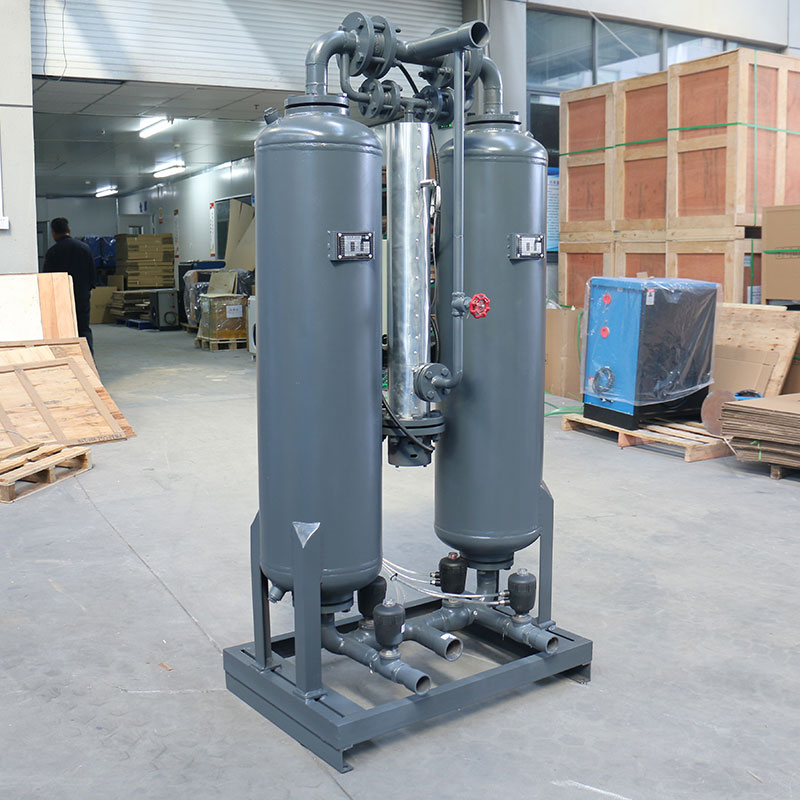
The dryer features two adsorption towers that operate alternately. While one tower removes moisture from compressed air, the other regenerates its desiccant using heated purge air. This configuration provides a continuous supply of dry compressed air without interrupting normal production.
With a rated pressure dew point of -40°C, the SRD Series is suitable for PSA nitrogen generation, precision manufacturing, electronics production, and other industrial processes requiring low-moisture compressed air.
Moist compressed air enters the adsorption tower and passes through the desiccant bed. The desiccant captures water vapor from the compressed air, allowing dry air to flow downstream into the nitrogen generator or other pneumatic equipment.
During regeneration, an integrated heater assists in releasing moisture from the saturated desiccant. A small portion of dry compressed air carries the released moisture out of the regeneration tower, restoring the adsorption capacity of the desiccant.
Heat-assisted regeneration reduces the amount of purge air required compared with conventional heatless adsorption dryers.
The two adsorption towers alternate between drying and regeneration. After regeneration, the regenerated tower returns to operating pressure before switching to the adsorption phase.
This alternating cycle maintains a continuous dry air supply and supports uninterrupted industrial production.
The SRD Series consumes approximately 5–8% of its rated airflow for regeneration, compared with the typical 12–15% required by conventional heatless desiccant air dryers.
Lower purge air consumption increases the amount of compressed air available for downstream equipment and reduces unnecessary compressor loading.
The heated regenerative desiccant air dryer achieves a pressure dew point of -40°C under rated operating conditions. Effective moisture removal helps protect downstream equipment against condensation, corrosion, and moisture-related contamination.
This drying performance is particularly useful for PSA nitrogen generators and moisture-sensitive manufacturing processes.
The integrated heating system operates during the regeneration phase rather than continuously throughout the entire drying cycle.
By combining electric heating with reduced purge airflow, the dryer helps limit compressed air losses. Overall energy consumption depends on equipment capacity, operating conditions, regeneration settings, and electricity costs.
The heat-assisted regeneration process supports efficient use of the desiccant bed and a compact twin-tower arrangement. The integrated equipment structure simplifies installation within compressed air treatment stations and nitrogen generation systems.
The SRD Series offers multiple equipment sizes to accommodate different production capacities and installation layouts.
The alternating adsorption and regeneration cycles allow the dryer to maintain a continuous supply of dry compressed air. This supports industrial processes that operate for extended periods and require consistent feed air quality.
The SRD Series includes 18 models with rated air delivery ranging from 1.2 to 155 m³/min. This range accommodates small compressed air installations, centralized air treatment stations, and large industrial nitrogen generation systems.
SRD Series Heated Desiccant Air Dryer
| Model | Air Delivery (m³/min) | Voltage (V/Hz) | Power (kW) | Inlet/Outlet (PT) | Dimension (mm) L×W×H | Weight (kg) |
|---|---|---|---|---|---|---|
| SRD-01 | 1.20 | 220V/50HZ | 1 | RC1” | 670×500×1305 | 135 |
| SRD-02 | 2.4 | 220V/50HZ | 1 | RC1” | 670×580×1685 | 170 |
| SRD-03 | 3.2 | 220V/50HZ | 1 | RC1” | 850×580×1450 | 240 |
| SRD-06 | 6.5 | 220V/50HZ | 2 | RC1 1/2” | 1025×700×1700 | 285 |
| SRD-08 | 8.5 | 220V/50HZ | 2 | RC2” | 1100×700×2050 | 255 |
| SRD-10 | 11.50 | 380V/50HZ | 3 | RC2” | 1200×500×2173 | 526 |
| SRD-12 | 13.50 | 380V/50HZ | 3 | RC2” | 1300×500×2183 | 605 |
| SRD-15 | 17.00 | 380V/50HZ | 5 | DN65 | 1280×820×2360 | 712 |
| SRD-20 | 23.00 | 380V/50HZ | 6 | DN80 | 1400×930×2530 | 848 |
| SRD-25 | 27.00 | 380V/50HZ | 8 | DN80 | 1650×990×2450 | 1150 |
| SRD-30 | 34.00 | 380V/50HZ | 9 | DN80 | 1700×955×2410 | 1328 |
| SRD-40 | 45.00 | 380V/50HZ | 12 | DN100 | 1950×1000×2550 | 1674 |
| SRD-50 | 55 | 380V/50HZ | 15 | DN100 | 2010×1170×2650 | 2100 |
| SRD-60 | 65 | 380V/50HZ | 18 | DN125 | 2160×1470×2705 | 2707 |
| SRD-80 | 85 | 380V/50HZ | 24 | DN150 | 2420×1550×2800 | 3573 |
| SRD-100 | 110 | 380V/50HZ | 30 | DN150 | 2500×1650×2800 | 4639 |
| SRD-120 | 130 | 380V/50HZ | 36 | DN150 | 2650×1650×2800 | 5100 |
| SRD-150 | 155 | 380V/50HZ | 45 | DN200 | 2800×1300×2900 | 5586 |
Heated and heatless desiccant air dryers both remove moisture through adsorption. Their main difference lies in how the saturated desiccant is regenerated.
The heated regenerative design uses electric heating to assist moisture removal, while a heatless dryer relies primarily on dry compressed air for regeneration.
| Comparison | Heated Regenerative Dryer | Conventional Heatless Dryer |
|---|---|---|
| Regeneration method | Heat and purge air | Purge air |
| Typical purge air consumption | 5–8% | 12–15% |
| Pressure dew point | -40°C under rated conditions | -40°C achievable |
| Electric heating requirement | Required | Not required |
| Compressed air consumption | Lower | Higher |
| Equipment structure | Twin towers with heating system | Twin towers without heating system |
| Maintenance requirements | Desiccant, valves, filters, and heater | Desiccant, valves, and filters |
| Operating cost considerations | Electricity and reduced purge losses | Higher compressed air purge losses |
| Typical applications | Continuous production and nitrogen generation | General industrial dry air systems |
For facilities with continuous compressed air demand, heated regeneration can reduce purge losses and improve compressed air utilization. Equipment selection should account for compressor energy consumption, heater power, operating hours, and required air quality.
PSA nitrogen generators require clean, dry compressed air for effective gas separation. Excessive moisture, oil, and airborne particles can affect the performance of the adsorption system.
A heated desiccant air dryer works alongside precision filters, moisture separators, and other air treatment equipment to provide suitable feed air for nitrogen production.
Carbon molecular sieves (CMS) are essential components of PSA nitrogen generators. Excessive moisture can interfere with their adsorption performance and reduce their effectiveness over time.
By removing water vapor before compressed air enters the nitrogen generator, the SRD Series helps maintain suitable operating conditions for the carbon molecular sieve and reduce moisture-related deterioration.
Consistent feed air quality supports stable nitrogen separation. The twin-tower drying system provides a continuous supply of dry compressed air, helping maintain reliable nitrogen production during extended operating periods.
A typical compressed air purification system includes:
Air compressor
Air receiver tank
Moisture separator
Precision pre-filter
Heated regenerative desiccant air dryer
Dust removal after-filter
PSA nitrogen generator
Nitrogen storage tank
Dry compressed air helps protect laser cutting optics, pneumatic components, and CNC machining equipment from moisture-related contamination. Effective air drying also reduces the risk of condensation within compressed air pipelines and precision equipment.
Pharmaceutical manufacturing and food processing facilities often require controlled compressed air quality. The SRD Series supports moisture removal in packaging, pneumatic conveying, production equipment, and nitrogen generation systems.
Additional filtration and air treatment may be required to meet specific production hygiene and purity standards.
Electronic component production and assembly require controlled environmental and process conditions. Low-moisture compressed air helps reduce condensation risks during precision cleaning, pneumatic operation, and nitrogen-assisted manufacturing.
Moisture in compressed air can contribute to coating defects, uneven finishes, and equipment contamination. A heated regenerative desiccant air dryer helps maintain suitable air quality for automotive paint booths, spray equipment, and surface treatment processes.
The SRD Series supports PSA nitrogen generation systems used in metal processing, protective atmosphere applications, packaging, and other industrial processes requiring an on-site nitrogen supply.
Dryer capacity should match the compressed air demand of downstream equipment while accounting for regeneration air consumption. The SRD Series offers capacities from 1.2 to 155 m³/min for different industrial production requirements.
For PSA nitrogen generation systems, dryer selection should be based on the generator's compressed air consumption rather than its nitrogen output alone.
Inlet air pressure and temperature influence desiccant adsorption capacity and dryer performance. Higher inlet temperatures generally increase the moisture load and may reduce effective drying capacity.
An appropriately sized aftercooler and moisture separator help maintain suitable inlet conditions and reduce the load on the desiccant bed.
Different industrial applications require different compressed air moisture levels. The SRD Series provides a rated -40°C pressure dew point, making it suitable for many moisture-sensitive production processes.
The required pressure dew point should be determined according to downstream equipment specifications, ambient conditions, and process requirements.
The SRD Series includes 220V/50Hz and 380V/50Hz models, with rated power ranging from 1 to 45 kW.
Equipment dimensions, connection sizes, electrical supply, maintenance clearance, and ventilation requirements should be considered when selecting a dryer for an existing or new compressed air system.
Install the heated desiccant air dryer in a dry, well-ventilated area with sufficient clearance for routine inspection and maintenance. The upstream compressed air system should include suitable filtration and condensate removal equipment to prevent liquid water, oil, and particles from entering the desiccant towers.
The dryer should be connected to a compressed air supply that meets its specified operating conditions.
Regular inspection helps maintain drying performance and reduce unexpected equipment downtime. Maintenance requirements depend on operating hours, inlet air quality, and environmental conditions.
| Maintenance Item | Recommended Action |
|---|---|
| Desiccant | Inspect for contamination, degradation, and reduced adsorption capacity |
| Pre-filters | Check differential pressure and replace filter elements as required |
| After-filters | Inspect for accumulated desiccant dust and flow restrictions |
| Heating system | Check heater operation and temperature controls |
| Switching valves | Inspect valve operation, sealing, and switching performance |
| Dew point | Monitor outlet pressure dew point for abnormal changes |
| Air connections | Inspect pipelines and fittings for compressed air leakage |
| Drain system | Check upstream condensate discharge |
Proper maintenance of the dryer and upstream air treatment equipment helps extend desiccant service life and maintain consistent compressed air quality.
A heated regenerative desiccant air dryer typically consumes less purge air because electric heating assists desiccant regeneration. The SRD Series requires approximately 5–8% purge air, while conventional heatless dryers typically require 12–15%. Total energy savings depend on compressor efficiency and heating requirements.
Desiccant typically requires replacement every two to five years, depending on compressed air quality, operating conditions, and maintenance practices. An increasing outlet dew point or abnormal pressure drop may indicate that the desiccant requires inspection.
High inlet temperatures reduce the moisture adsorption capacity of the desiccant. An aftercooler may be necessary when compressed air temperatures exceed the dryer's specified operating range, particularly in systems with inlet temperatures above approximately 49°C (120°F).
Excessive regeneration temperatures can degrade certain desiccant materials and reduce their adsorption capacity. The appropriate regeneration temperature depends on the desiccant type and dryer design. Proper temperature control helps prevent thermal damage.
Where compatible, a dew point control (DPC) system can adjust regeneration cycles according to actual drying demand. This helps reduce unnecessary heating and purge air consumption during periods of lower moisture load.
Yes. The dryer can be integrated into an existing PSA nitrogen generation system, provided its airflow capacity, operating pressure, connection dimensions, and outlet air quality match the system requirements.
Pre-filters remove oil aerosols and particles that could contaminate the desiccant. After-filters capture desiccant dust before it enters the nitrogen generator or other downstream equipment. Together, they help maintain compressed air quality.
Common causes include excessive inlet temperatures, insufficient regeneration, contaminated desiccant, valve leakage, heater malfunction, and airflow exceeding the rated capacity. Inspecting these components and operating conditions helps identify the source of reduced drying performance.
ROCKY offers SRD Series heated regenerative desiccant air dryers for PSA nitrogen generators and industrial compressed air purification systems. With capacities ranging from 1.2 to 155 m³/min, our product range accommodates different airflow demands and production requirements.
Contact our team with your required airflow, operating pressure, inlet temperature, and target pressure dew point to discuss equipment selection and system integration.