


| Quantity: | |
|---|---|
In simple terms, this dryer integrates pressure swing adsorption (PSA) with a small built-in heater to make the regeneration process more efficient. The two towers work in cycles—one removes moisture from the compressed air while the other is cleaned using a mix of purge air and gentle heat. This approach significantly cuts down on purge air waste compared to heatless dryers, while still delivering a stable -40°C pressure dew point.
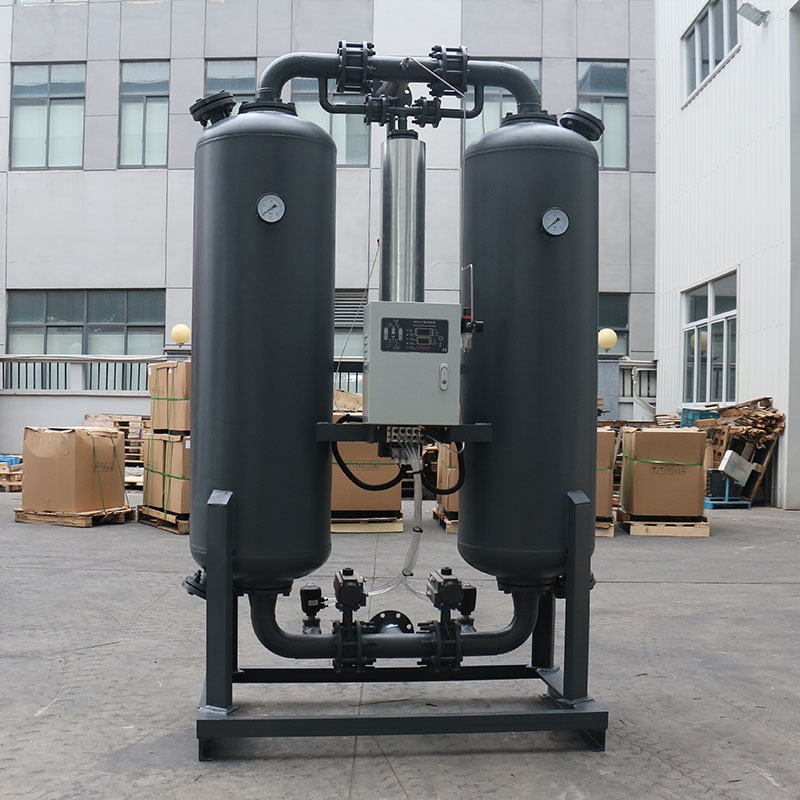
Reduced air loss – regeneration consumes just 5–8% of rated flow, versus 12–15% for heatless alternatives
Minimal power draw – a compact heater (typically under 2 kW) activates only during regeneration, keeping electricity costs low
Consistent drying – holds a reliable -40°C pressure dew point, even when inlet conditions fluctuate
Space-saving design – achieves the same capacity with smaller vessels than heatless models
Built to perform – suits operations that demand both energy efficiency and uncompromising air quality.
Technical Parameters
| SRD Series Heated desiccant air dryer | ||||||
| Model | Air Delivery (m3/min) | Voltage (V/HZ) | Power (kW) | Inlet/Outlet (PT) | Dimension (mm) | Weight (Kg) |
| L*W*H | ||||||
| SRD-80 | 85 | 380V/50HZ | 24 | DN150 | 2420*1550*2800 | 3573 |
| SRD-100 | 110 | 380V/50HZ | 30 | DN150 | 2500*1650*2800 | 4639 |
| SRD-120 | 130 | 380V/50HZ | 36 | DN150 | 2650*1650*2800 | 5100 |
| SRD-150 | 155 | 380V/50HZ | 45 | DN200 | 2800*1300*2900 | 5586 |
Laser cutting – protects optics and maintains beam stability
CNC machining – safeguards spindles and precision components from moisture
Pharmaceutical industry – complies with strict air purity standards
Food and beverage sector – ensures hygienic conditions and product integrity
Electronics manufacturing – prevents oxidation and humidity-related defects
Automotive finishing – guarantees smooth, defect-free paint application
Q1. What sets this dryer apart from a heatless model?
It incorporates a small heater during the regeneration phase, reducing purge air consumption from 12–15% down to 5–8%. This makes it a more efficient choice for medium-to-large-scale systems.
Q2. How much electricity does it use?
Very little. The heater only runs during regeneration cycles, with total power typically under 2–3 kW depending on the model—far less than heated blower dryers.
Q3. What level of dryness can it achieve?
It consistently maintains a pressure dew point of -40°C, meeting the requirements of most industrial applications that need reliable dry air.
Q4. Can it handle high-pressure setups like 16 bar?
Yes. It comes in both standard and high-pressure versions, with options rated for 16 bar and beyond.
Q5. What kind of maintenance is required?
Routine upkeep includes checking pre-filters, inspecting the heater and valves, and replacing the desiccant every 2–3 years depending on usage conditions.
Q6. When is a micro-heat dryer the better option?
It’s the right choice when reducing purge air waste and energy costs is a priority—especially for continuous operation or systems with flow rates above 2–3 m³/min


