


| Quantity: | |
|---|---|
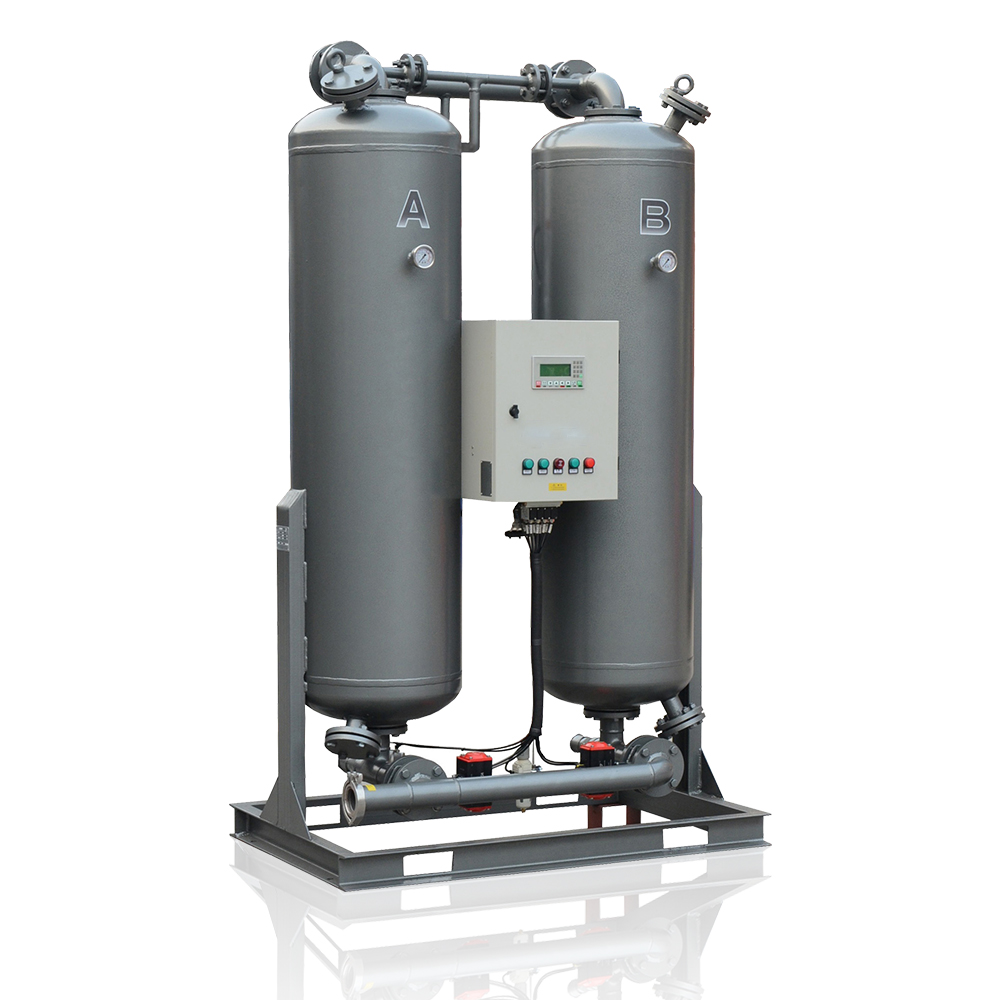
Heatless adsorption dryers (heatless regenerative adsorption dryers) use the pressure swing adsorption (PSA) principle to remove moisture from compressed air using adsorbents (such as molecular sieves and activated alumina) and restore the adsorbent's drying capacity through heatless regeneration.
Why It Stands Out
1. Provides reliable drying with a stable pressure dew point down to -40°C.
2. Runs without heaters, helping keep energy costs low.
3. Built tough for continuous use in demanding industrial settings.
4. Simple structure with few moving parts for easy upkeep.
Technical Parameters
| SXD Series Heatless desiccant air dryer | ||||||
| Model | Air Delivery (m3/min) | Voltage (V/HZ) | Power (kW) | Inlet/Outlet (PT) | Dimensions (mm) | Weight (Kg) |
| L*W*H | ||||||
| SXD-40 | 45 | 220V/50HZ | 0.2 | DN100 | 1950*1000*2550 | 1624 |
| SXD-50 | 55 | 220V/50HZ | 0.2 | DN100 | 2010*1170*2650 | 1624 |
| SXD-60 | 65 | 220V/50HZ | 0.2 | DN100 | 2160*1470*2705 | 2650 |
| SXD-80 | 85 | 220V/50HZ | 0.2 | DN125 | 2420*1550*2800 | 3520 |
Where It’s Used
Well suited for laser cutting, CNC machines, pneumatic systems, food packaging, and any application that requires clean, dry compressed air.
FAQ
Q3. What causes a sudden increase in outlet dew point (e.g., -20°C to 0°C)?
A. Adsorbent failure, adsorbent pulverization, valve leakage, or incomplete regeneration.
Q4. Does a heatless adsorption dryer require a power source?
A. Only control power is required: to drive the solenoid valve and controller (power <100W), no high-power electricity is required (unlike micro-heating types).
Q5. Which industries require heatless adsorption dryers?
A. Semiconductor manufacturing, medical ventilators, lithium battery coating, and food packaging.
Q6. What precautions should be taken when restarting after a shutdown?
A. Adsorbent regeneration: If the system has been down for >48 hours, the regeneration process must be manually initiated to prevent wet adsorbent from clumping.
Gradual loading: Start with a low flow rate for 10 minutes, then gradually increase the load.


