


| Quantity: | |
|---|---|
How It Works
Uses PSA plus a small built-in heater for regeneration. One tower dries the air while the other regenerates with purge air + low heat. Result: purge loss much lower than heatless dryers, with a stable -40°C pressure dew point.
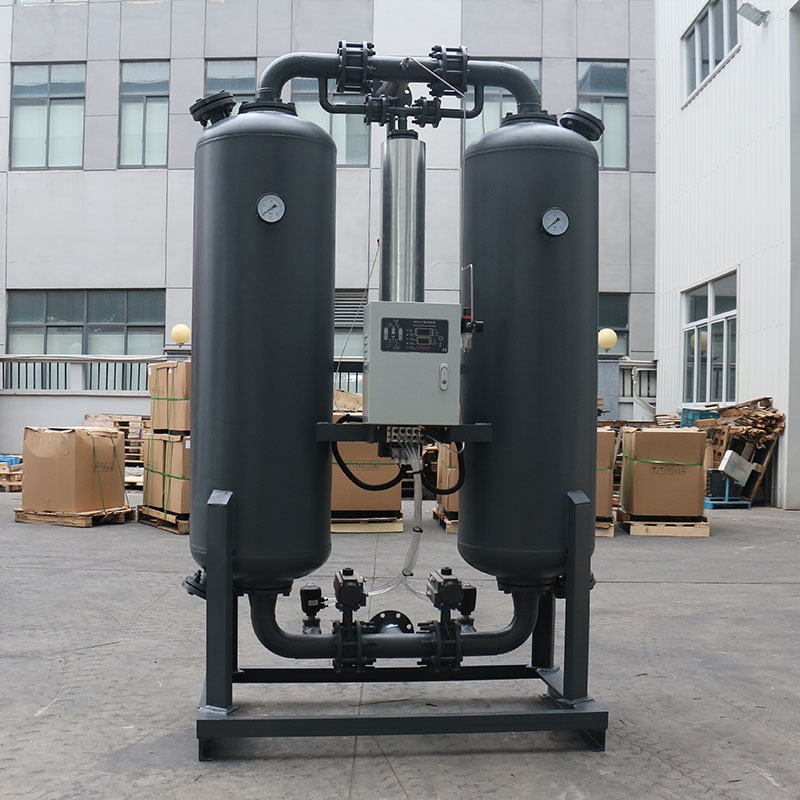
Product features
✅ Energy Saving: Uses less gas than heatless regeneration (requires only 5-8% regeneration gas, compared to 15% for heatless regeneration).
✅ Low Dew Point: Suitable for high drying requirements (such as in the pharmaceutical and electronics industries).
✅ Stable Operation: Dual towers operate alternately, providing continuous air supply.
✅ Lower Maintenance Cost: Desiccant life is longer than heatless regeneration.
| SRD Series Heated desiccant air dryer | ||||||
| Model | Air Delivery (m3/min) | Voltage (V/HZ) | Power (kW) | Inlet/ Outlet (PT) | Dimensions (mm) | Weight (Kg) |
| L*W*H | ||||||
| SRD-06 | 6.5 | 220V/50HZ | 2 | RC1 1/2” | 1025*700*1700 | 285 |
| SRD-08 | 8.5 | 220V/50HZ | 2 | RC2” | 1100*700*2050 | 255 |
| SRD-10 | 11.50 | 380V/50HZ | 3 | RC2” | 1200*500*2173 | 526 |
| SRD-12 | 13.50 | 380V/50HZ | 3 | RC2” | 1300*500*2183 | 605 |
Main Application Areas
Laser cutting, CNC machining, pharmaceuticals, food & beverage, electronics, automotive painting
Q1: Which is more gas-efficient, micro-heating or heatless adsorption?
Micro-heating is more gas-efficient (regeneration gas consumption is lower, and heating improves efficiency).
Q2: What dew point can be achieved?
-40°C to -70°C (better than refrigeration, closer to heatless adsorption).
Q3: How often should the desiccant be replaced?
3-5 years (depending on air quality; replacement is required when the dew point rises).
Q4: Is it suitable for high-temperature environments?
A precooler is required, as adsorbent efficiency decreases at high temperatures.
Q5: Is it more expensive than a refrigerated dryer?
The initial investment is higher, but the long-term energy savings make it suitable for demanding industries.


