


| Quantity: | |
|---|---|
SXD-10
Rocky
This dryer utilizes pressure swing adsorption (PSA) technology to eliminate moisture from compressed air systems. It operates with two alternating vessels—while one vessel actively removes water vapor from the incoming air, the other undergoes regeneration by venting a small volume of already-dried air to the atmosphere. The entire cycle runs without any external heat input.
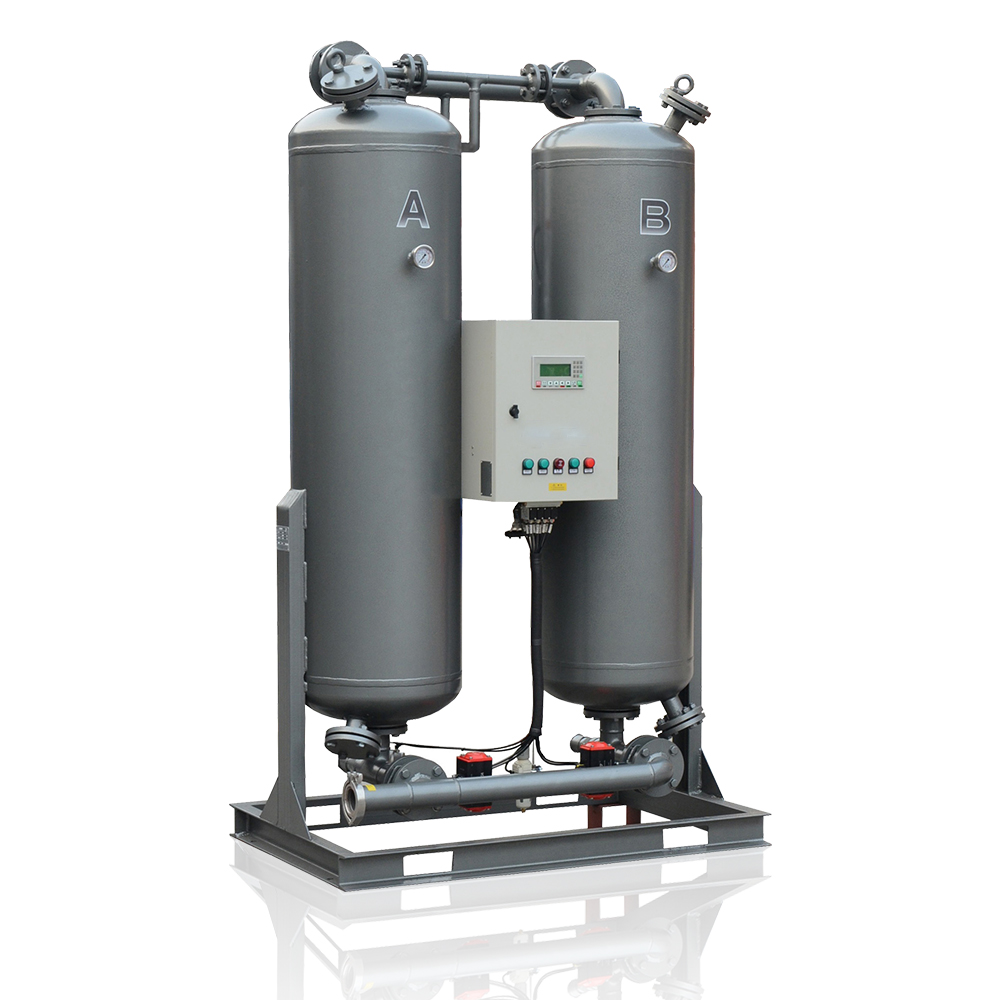
Exceptional drying capability – guarantees a pressure dew point down to -40°C, effectively preventing rust, corrosion, and freeze damage in downstream equipment.
Economical to run – consumes no electricity during regeneration; only a small percentage of compressed air is used as purge, minimizing utility expenses.
Built to endure – engineered with robust components that withstand continuous 24/7 operation in dusty, high-temperature, or otherwise challenging industrial conditions.
Service-friendly design – features easily accessible valves and a straightforward control system, allowing quick inspections and reducing technician time.
SXD Series Heatless desiccant air dryer | ||||||
| Model | Air Delivery (m3/min) | Voltage (V/HZ) | Power (kW) | Inlet/Outlet (PT) | Dimensions (mm) | Weight (Kg) |
| L*W*H | ||||||
| SXD-01 | 1.20 | 220V/50HZ | 0.2 | RC1” | 670*460*1305 | 105 |
| SXD-02 | 2.4 | 220V/50HZ | 0.2 | RC1” | 670*450*1485 | 135 |
| SXD-03 | 3.2 | 220V/50HZ | 0.2 | RC1” | 850*500*1385 | 187 |
| SXD-06 | 6.5 | 220V/50HZ | 0.2 | RC1 1/2” | 1000*700*1700 | 238 |
| SXD-08 | 8.5 | 220V/50HZ | 0.2 | RC2” | 1100*700*2050 | 282 |
| SXD-10 | 11.50 | 220V/50HZ | 0.2 | RC2” | 1200*700*2030 | 466 |
| SXD-12 | 13.50 | 220V/50HZ | 0.2 | RC2” | 1300*700*2280 | 520 |
| SXD-15 | 17.00 | 220V/50HZ | 0.2 | DN65 | 1300*820*2480 | 670 |
| SXD-20 | 23.00 | 220V/50HZ | 0.2 | DN80 | 1380*820*2530 | 798 |
| SXD-25 | 27.00 | 220V/50HZ | 0.2 | DN80 | 1650*900*2450 | 980 |
| SXD-30 | 34.00 | 220V/50HZ | 0.2 | DN80 | 1700*955*2410 | 1278 |
| SXD-40 | 45.00 | 220V/50HZ | 0.2 | DN100 | 1950*1000*2550 | 1624 |
| SXD-50 | 55 | 220V/50HZ | 0.2 | DN100 | 2010*1170*2650 | 1624 |
| SXD-60 | 65 | 220V/50HZ | 0.2 | DN100 | 2160*1470*2705 | 2650 |
| SXD-80 | 85 | 220V/50HZ | 0.2 | DN125 | 2420*1550*2800 | 3520 |
| SXD-100 | 110 | 220V/50HZ | 0.2 | DN150 | 2500*1650*2800 | 4320 |
| SXD-120 | 130 | 220V/50HZ | 0.2 | DN150 | 2650*1650*2800 | 4750 |
| SXD-150 | 155 | 220V/50HZ | 0.2 | DN200 | 2800*1700*2900 | 5260 |
This dryer is widely adopted across industries where compressed air quality directly affects production outcomes. In laser cutting operations, it prevents optical contamination that can compromise cut precision. For CNC machinery, it ensures consistent tool performance and extends spindle life. It is also essential in pharmaceutical manufacturing, electronics assembly, automotive painting, and beverage bottling—where even trace moisture can cause product rejects or equipment failure.
FAQ
Q1. How does a heatless adsorption dryer work?
It uses a dual-tower PSA system. While one tower adsorbs moisture, the other regenerates using a small amount of dry air (12–15%). The towers automatically switch every 4–10 minutes for continuous operation.
Q2. Is 15% regeneration air consumption a waste? How can it be reduced?
Regeneration air is necessary for physical adsorption. Consumption can be optimized by right-sizing the dryer and using a dew-point energy-saving control system, which can reduce it to 8–10%.
Q3. What causes a sudden increase in outlet dew point (e.g., -20°C to 0°C)?
Possible causes include adsorbent failure or pulverization, valve leakage, or incomplete regeneration.
Q4. Does a heatless adsorption dryer require a power source?
Only low-power control power (<100W) for solenoid valves and the controller—no high-power electricity is needed.
Q5. Which industries require heatless adsorption dryers?
Semiconductor manufacturing, medical ventilators, lithium battery coating, and food packaging.
Q6. What precautions should be taken when restarting after a shutdown?
If shutdown exceeds 48 hours, manually initiate regeneration to prevent adsorbent clumping. Start with a low flow rate for 10 minutes, then gradually increase to full load.


