


| Quantity: | |
|---|---|
A micro-heat adsorption air dryer combines pressure swing adsorption (PSA) with a low-power internal heater to enhance regeneration efficiency. While one tower dries the compressed air, the other undergoes regeneration using a small amount of purge air combined with controlled heating. This reduces purge air consumption significantly compared to heatless dryers, while maintaining a stable pressure dew point as low as -40°C.
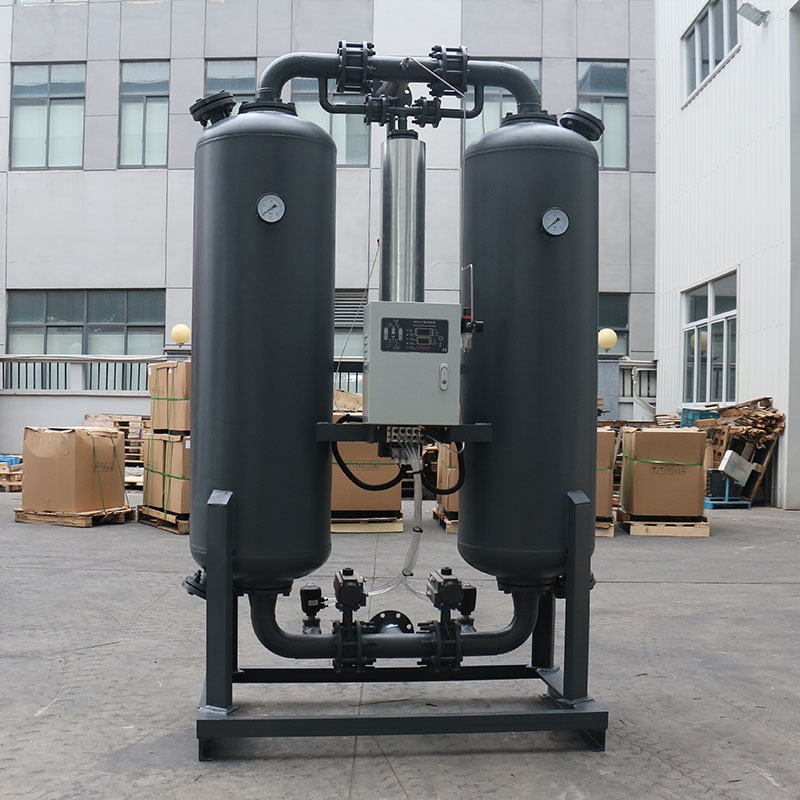
Product features
Lower purge loss – consumes only 5–8% of rated flow for regeneration, versus 12–15% for heatless dryers.
Energy efficient – uses a small internal heater (typically <2 kW) only during the regeneration phase, minimizing overall power consumption.
Stable dew point – delivers consistent -40°C pressure dew point even under fluctuating inlet conditions.
Compact footprint – smaller vessel size compared to heatless dryers for the same flow rate.
Reliable performance – ideal for applications where energy savings and consistent air quality are both priorities.
Technical Parameters
| SRD Series Heated desiccant air dryer | ||||||
| Model | Air Delivery (m3/min) | Voltage (V/HZ) | Power (kW) | Inlet/Outlet (PT) | Dimension (mm) | Weight (Kg) |
| L*W*H | ||||||
| SRD-15 | 17 | 380V/50HZ | 5 | DN65 | 1280*820*2360 | 712 |
| SRD-20 | 23 | 380V/50HZ | 6 | DN80 | 1400*930*2530 | 848 |
| SRD-25 | 27 | 380V/50HZ | 8 | DN80 | 1650*990*2450 | 1150 |
Main Application Areas
Laser cutting – prevents lens contamination and ensures stable beam quality
CNC machining – protects spindles and precision tools from moisture damage
Pharmaceutical manufacturing – meets strict air purity requirements
Food and beverage packaging – maintains hygiene and prevents product spoilage
Electronics assembly – avoids oxidation and moisture-related defects
Automotive painting – ensures flawless finish by eliminating moisture in spray lines
FAQ
Q1. What’s the difference between a micro-heat dryer and a heatless dryer?
A micro-heat dryer uses a small heater during regeneration to reduce purge air consumption (5–8% vs. 12–15%), making it more energy-efficient for medium to large flow applications.
Q2. How much electricity does it consume?
Power consumption is low. The heater typically operates only during the regeneration cycle, and total power is usually under 2–3 kW depending on the model—far less than heated blower dryers.
Q3. What pressure dew point can it achieve?
It consistently delivers a pressure dew point of -40°C, suitable for most industrial applications requiring dry compressed air.
Q4. Is it suitable for high-pressure systems (e.g., 16 bar)?
Yes, micro-heat adsorption dryers are available in standard and high-pressure versions, including models rated for 16 bar and above.
Q5. What maintenance does it require?
Routine maintenance includes checking pre-filters, inspecting the heater and valves, and replacing desiccant every 2–3 years depending on operating conditions.
Q6. When should I choose a micro-heat dryer over a heatless one?
Choose a micro-heat dryer when you want to reduce purge air loss and energy costs, especially for systems running continuously or with flow rates above 2–3 m³/min.


