


| Quantity: | |
|---|---|
SRD-20
Rocky
At a Glance
This dryer uses pressure swing adsorption (PSA) and a small integrated heater to make regeneration more efficient. While one tower dries the compressed air, the other undergoes regeneration using a mix of purge air and gentle heat. The design cuts purge air loss significantly compared to heatless models and holds a consistent -70°C pressure dew point.
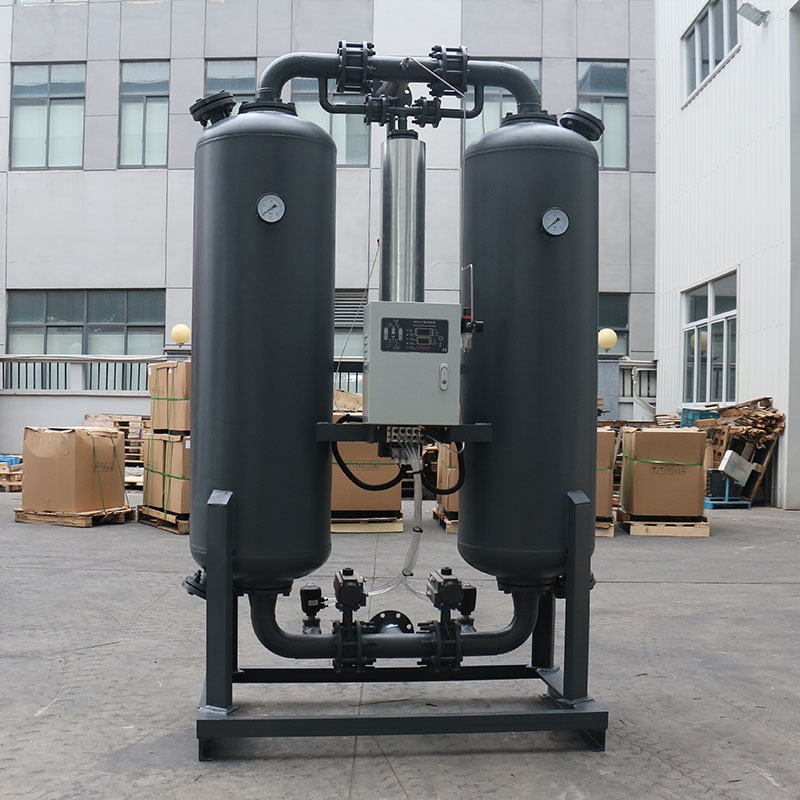
At a Glance
This dryer uses pressure swing adsorption (PSA) and a small integrated heater to make regeneration more efficient. While one tower dries the compressed air, the other undergoes regeneration using a mix of purge air and gentle heat. The design cuts purge air loss significantly compared to heatless models and holds a consistent -40°C pressure dew point.
Technical Parameters
| SRD Series Heated desiccant air dryer | ||||||
| Model | Air Delivery (m3/min) | Voltage (V/HZ) | Power (kW) | Inlet/Outlet (PT) | Dimension (mm) | Weight (Kg) |
| L*W*H | ||||||
| SRD-01 | 1.20 | 220V/50HZ | 1 | RC1” | 670*500*1305 | 135 |
| SRD-02 | 2.4 | 220V/50HZ | 1 | RC1” | 670*580*1685 | 170 |
| SRD-03 | 3.2 | 220V/50HZ | 1 | RC1” | 850*580*1450 | 240 |
| SRD-06 | 6.5 | 220V/50HZ | 2 | RC1 1/2” | 1025*700*1700 | 285 |
| SRD-08 | 8.5 | 220V/50HZ | 2 | RC2” | 1100*700*2050 | 255 |
| SRD-10 | 11.50 | 380V/50HZ | 3 | RC2” | 1200*500*2173 | 526 |
| SRD-12 | 13.50 | 380V/50HZ | 3 | RC2” | 1300*500*2183 | 605 |
| SRD-15 | 17.00 | 380V/50HZ | 5 | DN65 | 1280*820*2360 | 712 |
| SRD-20 | 23.00 | 380V/50HZ | 6 | DN80 | 1400*930*2530 | 848 |
| SRD-25 | 27.00 | 380V/50HZ | 8 | DN80 | 1650*990*2450 | 1150 |
| SRD-30 | 34.00 | 380V/50HZ | 9 | DN80 | 1700*955*2410 | 1328 |
| SRD-40 | 45.00 | 380V/50HZ | 12 | DN100 | 1950*1000*2550 | 1674 |
| SRD-50 | 55 | 380V/50HZ | 15 | DN100 | 2010*1170*2650 | 2100 |
| SRD-60 | 65 | 380V/50HZ | 18 | DN125 | 2160*1470*2705 | 2707 |
| SRD-80 | 85 | 380V/50HZ | 24 | DN150 | 2420*1550*2800 | 3573 |
| SRD-100 | 110 | 380V/50HZ | 30 | DN150 | 2500*1650*2800 | 4639 |
| SRD-120 | 130 | 380V/50HZ | 36 | DN150 | 2650*1650*2800 | 5100 |
| SRD-150 | 155 | 380V/50HZ | 45 | DN200 | 2800*1300*2900 | 5586 |
Typical Applications
Laser cutting – protects optics and ensures consistent beam quality.
CNC machinery – guards spindles and precision components against moisture.
Pharmaceuticals – aligns with strict air purity regulations.
Food and beverage – supports hygiene standards and product safety.
Electronics – prevents oxidation and humidity-related issues.
Automotive painting – contributes to smooth, defect-free finishes.
Questions & Answers
Q1. What makes this different from a heatless dryer?
It includes a small heater during regeneration, which reduces purge air consumption from 12–15% down to 5–8%—making it especially suitable for medium-to-large systems where efficiency is a priority.
Q2. How much power does it use?
Very little. The heater only runs during regeneration cycles, and total power typically stays under 2–3 kW depending on the model—far less than heated blower dryers.
Q3. What level of dryness can it provide?
A steady -40°C pressure dew point, which covers the needs of most industrial applications that require dry compressed air.
Q4. Is it suitable for high-pressure environments like 16 bar?
Yes. It comes in both standard and high-pressure versions, with options rated for 16 bar and above.
Q5. What does regular maintenance look like?
Routine tasks include inspecting pre-filters, checking the heater and valves, and replacing desiccant every 2–3 years—depending on operating conditions.
Q6. When is a micro-heat dryer the better choice?
Opt for it when reducing purge air loss and energy costs matters most—particularly for continuous operation or systems with flow rates above 2–3 m³/min.


