


| Quantity: | |
|---|---|
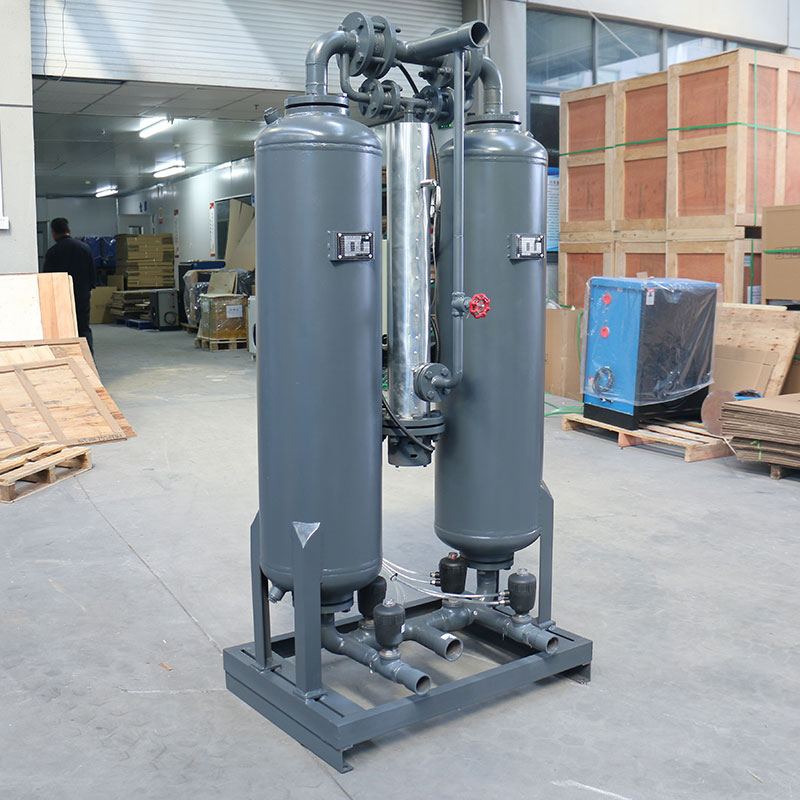
A heated desiccant air dryer uses an adsorbent to remove moisture from compressed air, restoring the desiccant's moisture absorption capacity through heating. Its core feature is its thermal regeneration technology, which reduces energy consumption and increases efficiency compared to non-heated desiccant dryers.
Working Principle
Adsorption Phase: Wet air passes through the desiccant tower, where moisture is adsorbed and dry air is output.
Regeneration Phase: A heater heats the desiccant, desorbing moisture. A small amount of dry air (regeneration gas) then removes the moisture, restoring adsorption capacity.
The two towers operate alternately: one tower adsorbs while the other regenerates, ensuring a continuous air supply.
Why It Stands Out
Purge air consumption is just 5–8% of rated flow—heatless dryers require 12–15%
A compact heater (usually under 2 kW) activates only during regeneration, so energy costs stay low
Delivers consistent -70°C dew point even when inlet conditions fluctuate
Takes up less floor space—vessels are smaller than those in heatless dryers with equivalent capacity
Designed for operations where energy efficiency and uncompromising air quality go hand in hand
Technical Parameters
| SRD Series Heated desiccant air dryer | ||||||
| Model | Air Delivery (m3/min) | Voltage (V/HZ) | Power (kW) | Inlet/Outlet (PT) | Dimension (mm) | Weight (Kg) |
| L*W*H | ||||||
| SRD-01 | 1.20 | 220V/50HZ | 1 | RC1” | 670*500*1305 | 135 |
| SRD-02 | 2.4 | 220V/50HZ | 1 | RC1” | 670*580*1685 | 170 |
| SRD-03 | 3.2 | 220V/50HZ | 1 | RC1” | 850*580*1450 | 240 |
Main Application Areas
1. Pharmaceutical & Food Industries: Sterile Compressed Air (Preventing Microbial Growth)
2. Electronics & Semiconductors: Preventing Moisture and Oxidation of Precision Components
3. Petrochemical & Energy: Instrument Air and Natural Gas Drying
4. Spraying & Painting: Preventing Bubbles and Impurities on Paint
5. Laboratories & Precision Instruments: High-Purity Gas Requirements
FAQ
Q1: Which is more gas-efficient, heated adsorption or heatless adsorption?
✅ Heated adsorption is more energy-efficient because it uses electric heating for regeneration and requires only a small amount of compressed air (approximately 5-7%); heatless adsorption, on the other hand, consumes 15% of compressed air for purge regeneration.
Q2: How often should the desiccant be replaced?
⏳ Typically, every 2-5 years (depending on air quality and frequency of use). If the dew point rises or the pressure drop increases, the desiccant should be inspected.
Q3: Can it be used with high-temperature compressed air?
️ An aftercooler is required because the adsorbent's adsorption capacity decreases at high temperatures (>120°F).
Q4: Will heated regeneration damage the desiccant?
⚠️ Overheating (>300°F) can cause the molecular sieve to fail, so an appropriate regeneration temperature should be selected (usually around 250°F).
Q5: How can I reduce energy consumption?
Adopt dew point control (DPC) system to adjust the regeneration cycle according to demand to avoid overheating.


