


| Quantity: | |
|---|---|
The Rocky SXD Series Industrial Heatless Adsorption Air Dryer is designed to remove moisture from compressed air systems requiring consistently low pressure dew points. It uses pressure swing adsorption (PSA) technology to deliver dry compressed air with a pressure dew point as low as -40°C under suitable operating conditions.
The dual-tower structure enables continuous adsorption and regeneration without external heating. While one tower removes moisture from compressed air, the other regenerates its desiccant using a portion of the dried air. With air delivery capacities ranging from 85 to 155 m³/min, the SXD Series supports large-scale industrial compressed air systems.
Its simple mechanical structure and automatic operating cycle make it suitable for production facilities where stable air quality, continuous operation, and convenient maintenance are important.
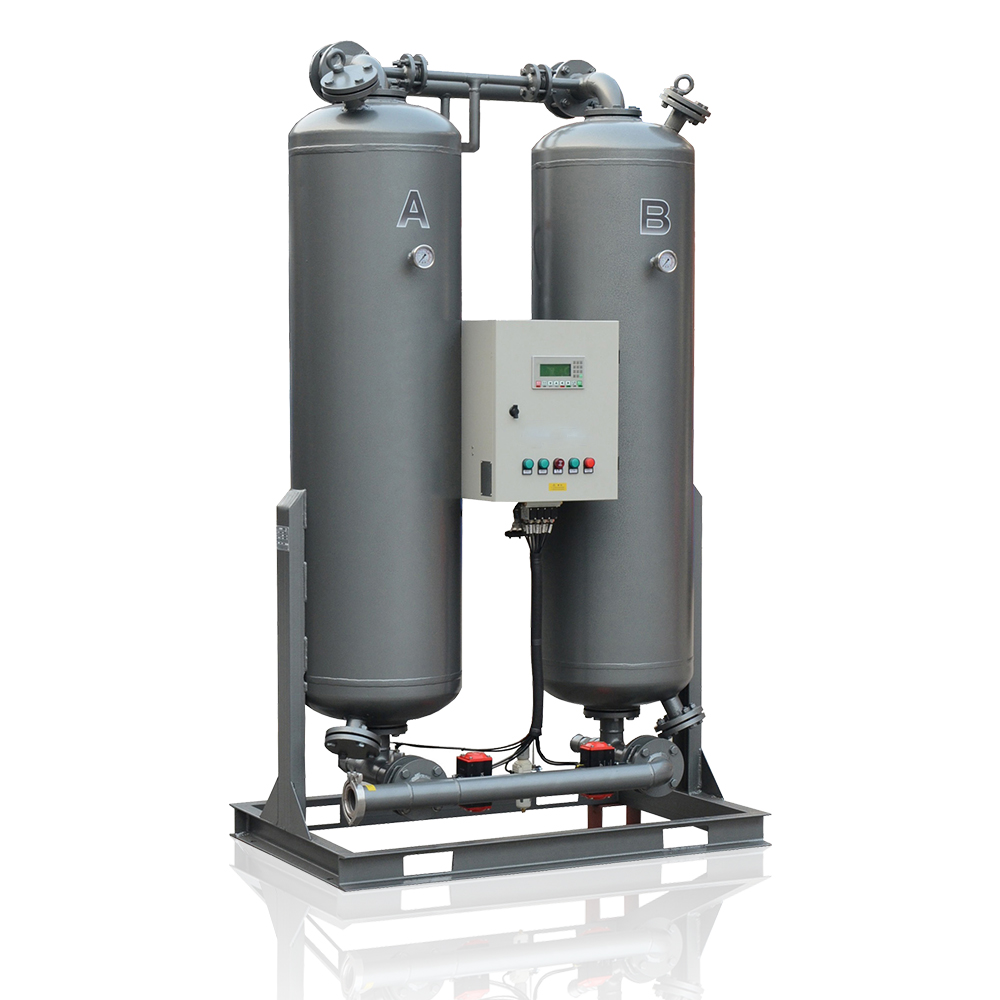
The heatless desiccant air dryer operates through a dual-tower pressure swing adsorption system. Moisture is removed through physical adsorption rather than refrigeration or external heating.
Compressed air enters the adsorption tower and passes through a desiccant bed. Adsorbent materials, such as activated alumina or molecular sieves, capture water vapor from the compressed air, reducing its pressure dew point.
A portion of the dried compressed air is expanded to a lower pressure and directed through the regeneration tower. This purge air removes accumulated moisture from the desiccant bed without requiring an external heating element.
The two adsorption towers automatically alternate between drying and regeneration, typically within a 4–10 minute switching cycle, depending on the control settings. This alternating process maintains a continuous supply of dry compressed air.
The heatless adsorption air dryer delivers a pressure dew point as low as -40°C, helping reduce condensation, moisture-related corrosion, and pneumatic equipment failures.
The system regenerates the desiccant without external heating elements. This eliminates dedicated regeneration heating requirements and simplifies the electrical system.
Designed for continuous industrial operation, the SXD Series supports large compressed air systems and demanding manufacturing environments.
Four available models provide rated air delivery capacities from 85 to 155 m³/min, accommodating different industrial compressed air demands.
The dual-tower system automatically controls adsorption, regeneration, and tower switching, reducing the need for routine manual intervention.
A straightforward mechanical structure with relatively few moving parts simplifies routine inspection, component servicing, and maintenance.
SXD Series Heatless Desiccant Air Dryer
| Model | Air Delivery (m³/min) | Voltage (V/Hz) | Power (kW) | Inlet/Outlet (PT) | Dimensions (L × W × H, mm) | Weight (kg) |
|---|---|---|---|---|---|---|
| SXD-80 | 85 | 220V/50HZ | 0.2 | DN125 | 2420 × 1550 × 2800 | 3520 |
| SXD-100 | 110 | 220V/50HZ | 0.2 | DN150 | 2500 × 1650 × 2800 | 4320 |
| SXD-120 | 130 | 220V/50HZ | 0.2 | DN150 | 2650 × 1650 × 2800 | 4750 |
| SXD-150 | 155 | 220V/50HZ | 0.2 | DN200 | 2800 × 1700 × 2900 | 5260 |
Heatless adsorption dryers typically use approximately 12–15% of dried compressed air for desiccant regeneration. This purge air is necessary to remove accumulated moisture and restore the adsorption capacity of the desiccant.
Although the system requires no external regeneration heater, producing purge air still consumes compressor energy. Dryer selection should therefore consider both electrical power consumption and regeneration air requirements.
When equipped with a dew point-based energy-saving control system, regeneration cycles can be adjusted according to actual moisture loads. Under suitable operating conditions, this approach may reduce regeneration air consumption to approximately 8–10%.
Selecting a dryer according to actual compressed air demand helps balance drying performance and operating costs. Proper sizing, stable inlet conditions, and effective upstream filtration also contribute to reliable operation.
The Rocky SXD Series Heatless Adsorption Air Dryer supports industrial processes where moisture control is essential to equipment reliability and product quality.
Dry compressed air helps protect pneumatic components and reduces moisture-related contamination during laser cutting operations.
Low-moisture compressed air supports pneumatic tool operation, automatic tool changing systems, and precision machining equipment.
Consistent air quality helps reduce internal corrosion, valve sticking, and moisture-related failures in pneumatic cylinders and control systems.
Dry compressed air supports packaging equipment and pneumatic production systems. Applications involving direct food contact require appropriate filtration and air purity control.
Low-dew-point compressed air supports moisture-sensitive manufacturing equipment and precision production processes where the required air purity specifications are met.
Controlled compressed air moisture levels support battery coating equipment and other moisture-sensitive production processes.
Heatless adsorption technology can be incorporated into medical compressed air treatment systems when the complete system meets applicable medical air quality and safety requirements.
Choosing an industrial compressed air adsorption dryer requires consideration of actual operating conditions rather than rated airflow alone.
| Selection Factor | Considerations |
|---|---|
| Air Delivery Capacity | Match dryer capacity to compressed air demand and regeneration requirements. |
| Pressure Dew Point | Determine the moisture level required by downstream equipment. |
| Operating Pressure | Match the dryer to the compressed air system pressure. |
| Inlet Air Temperature | Consider temperature variations and incoming moisture loads. |
| Regeneration Air | Evaluate purge air consumption and available compressor capacity. |
| Air Filtration | Use suitable upstream and downstream filtration to protect the desiccant and equipment. |
| Installation Space | Consider equipment dimensions, piping connections, and maintenance clearance. |
| Power Supply | Ensure compatibility with the available electrical supply. |
Proper dryer selection helps maintain stable compressed air quality while avoiding unnecessary energy consumption and insufficient drying capacity.
Inspect upstream filters and condensate drains regularly. Excessive liquid water, oil contamination, and solid particles can reduce desiccant performance and shorten its service life.
Monitor outlet pressure dew point and inspect the desiccant for contamination, deterioration, or excessive dust formation. Replace degraded adsorbent when necessary to restore drying performance.
Regularly inspect switching valves, solenoid valves, purge circuits, and piping connections. Air leakage and incomplete valve switching can affect regeneration efficiency and outlet air quality.
Following an extended shutdown, check the desiccant condition and perform regeneration when required. Introduce compressed air gradually and confirm that the outlet pressure dew point has stabilized before returning the dryer to full-load operation.
Routine monitoring of outlet dew point, inlet conditions, pressure drop, and regeneration performance helps identify developing problems before they interrupt production.
A heatless adsorption air dryer uses two desiccant towers to remove water vapor from compressed air. One tower performs adsorption while the other regenerates using dry purge air. The towers automatically alternate to maintain continuous drying.
Yes. Purge air removes accumulated moisture from the desiccant during regeneration. Correct dryer sizing and dew point-based regeneration control can help reduce unnecessary compressed air consumption.
Common causes include desiccant deterioration, adsorbent pulverization, switching valve leakage, excessive inlet moisture, and incomplete regeneration. Inspecting these components helps identify the source of reduced drying performance.
Yes. Electricity is required to operate the controller, solenoid valves, and automatic switching system. However, no external electrical heater is required for desiccant regeneration. The listed SXD Series models have a rated power of 0.2 kW.
Heatless adsorption dryers remove water vapor through desiccant adsorption and can achieve lower pressure dew points. Refrigerated air dryers remove moisture by cooling compressed air and condensing water vapor.
Inspect the desiccant and operating system before restarting. Perform regeneration if necessary, gradually increase airflow, and verify outlet air quality before resuming normal production.
The primary function of an adsorption dryer is moisture removal. Suitable upstream coalescing filters should be installed to remove oil aerosols and protect the desiccant from contamination.
Replacement intervals depend on inlet air quality, operating temperature, regeneration effectiveness, and operating hours. A persistent increase in outlet dew point may indicate that the desiccant requires inspection or replacement.
Yes. Its dual-tower adsorption and regeneration design supports continuous compressed air drying when operated within suitable conditions and maintained regularly.
Looking for a reliable heatless adsorption air dryer for your industrial compressed air system?
Rocky Compressor offers SXD Series heatless desiccant air dryers with air delivery capacities from 85 to 155 m³/min. Contact our team with your required airflow, operating pressure, inlet temperature, and target pressure dew point to discuss suitable equipment for your application.


