


| Quantity: | |
|---|---|
The ROCKY oil-free CO₂ booster compressor raises low- or medium-pressure carbon dioxide for cylinder filling, extraction, gas recovery, and other industrial processes. Standard models reach up to 200 bar, with custom configurations up to 350 bar. Flow, motor voltage, and controls can be matched to the application.
The ROCKY CO₂ booster compressor takes in low- or medium-pressure carbon dioxide from an existing gas supply and raises it to the pressure required by downstream equipment. The compression chamber runs dry, so the gas does not come into contact with lubricating oil inside the chamber. This helps protect oil-sensitive processes such as beverage carbonation and supercritical fluid extraction.
The booster uses stainless steel components, gas-tight seals, and cooling for demanding industrial duty. A cylinder filling line needs enough flow to meet its fill cycle as supply pressure changes. An extraction system may require a different control setup to match how it draws CO₂ during operation.
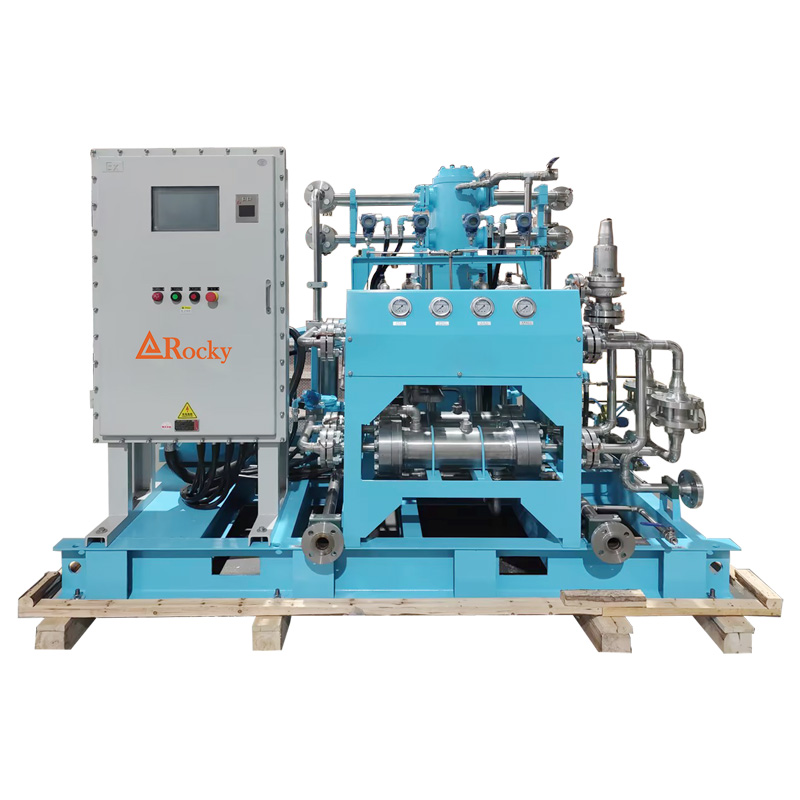
The compression chamber operates without lubricating oil, eliminating lubricant carryover from the chamber itself. This reduces the oil-removal requirements associated with that compression stage. Overall gas quality depends on the incoming CO₂ and the rest of the system.
Stainless steel components help resist corrosion when the CO₂ contains moisture. Gas-tight seals help limit leakage and retain CO₂ in the gas circuit. The gas composition and moisture content help determine material selection and any gas treatment needed for the installation.
Standard models offer discharge pressures up to 200 bar. Custom configurations can reach up to 350 bar. Available flow ranges from 10 to over 800 Nm³/h, depending on inlet pressure and the required discharge pressure. Each model’s rated flow applies at its specified operating conditions.
The lowest expected inlet pressure is an important sizing condition. When a cylinder bank supplies the booster, its pressure falls as gas is withdrawn. A flow rating based on the initial inlet pressure can overstate the capacity available later in the cycle.
ROCKY designs these boosters for continuous industrial service. Cooling and wear-resistant components support extended operating hours. Typical routine service intervals range from 4,000 to 8,000 operating hours, depending on the model and operating conditions.
The compact layout and low-noise design suit plants and laboratories where floor space and noise matter. The gas flow path is designed to reduce energy losses during compression. Power demand at the required inlet pressure, outlet pressure, and flow provides a basis for comparing operating costs.
Motor options include 380 V / 50 Hz, 400 V / 50 Hz, and 460 V / 60 Hz. Explosion-proof motors are available for projects with hazardous-area requirements. Motor and control selections depend on the site’s electrical supply and installation requirements.
Controls can be configured to match the demand pattern of a cylinder filling line or interface with an existing plant control system. The control scope depends on how the booster will start, stop, and respond to downstream demand.
Food and beverage. CO₂ supply for carbonation, flash freezing, and modified-atmosphere packaging.
Pharmaceutical and medical gas systems. CO₂ boosting for botanical supercritical fluid extraction and applications with a specified medical gas grade.
Chemical and petrochemical processing. Pressure boosting for chemical synthesis, urea production, reactor pressurization, and enhanced oil recovery.
Industrial manufacturing. CO₂ supply for compatible laser cutting equipment, dry ice blasting systems, and environmental test chambers.
Carbon capture, utilization, and storage. Compression of captured CO₂ for compatible downstream recovery, use, or storage systems.
Cylinder filling and fire suppression. Gas boosting for CO₂ cylinder filling and high-pressure CO₂ storage in fixed fire suppression systems.
Laboratories and research. Pressurized CO₂ supply for analytical instruments and research equipment.
Sizing starts with the CO₂ source, inlet pressure range, gas composition, moisture content, and inlet temperature. A steady plant header supplies gas differently from a cylinder bank whose pressure falls during use. Short filling cycles and continuous production can also call for different flow capacities and controls, even at the same discharge pressure.
The scope of supply can include project-specific requirements for gas treatment, instrumentation, and integration with existing equipment. Specifying flow at the required discharge pressure gives ROCKY a defined operating point for model selection.
ROCKY supplies compressors and gas boosters for industrial projects. CO₂ booster configurations can be matched to the required pressure, flow, operating schedule, and plant utilities. For export orders, shipping arrangements and customs documentation depend on the destination.
Gas drying is a separate process. Moisture or particles already present in the CO₂ may require a dryer or filter suited to the gas stream and the application’s quality limits.
Food, beverage, and medical gas grades depend on the incoming gas specification and the quality controls across the system. Gas grade and documentation requirements vary by application.
Yes, if the remaining cylinder pressure and gas conditions fall within the selected model’s rated inlet limits. Recovery capacity depends on how far the source pressure falls during transfer.
The booster is designed for gaseous CO₂ at the inlet. A liquid CO₂ source requires a supply arrangement that delivers vapor within the selected booster’s rated inlet conditions.
Flow in Nm³/h is based on specified reference conditions. Check that quotes use the same reference temperature and pressure. If your plant specifies flow in kg/h, include that mass flow in the inquiry.
Useful documents include performance data at your operating point, dimension and connection drawings, and a list of included equipment. For continuous operation, compare the cooling requirements and the model-specific maintenance schedule.
The motor rating applies to the motor. Package suitability depends on the other installed components, the site’s area classification, and the project’s documentation requirements.
Yes. For orders to South Africa, Russia, or other markets, ROCKY reviews available routes and shipping documents based on the destination and delivery terms.
Send ROCKY your CO₂ inlet pressure range, target discharge pressure, required flow rate, and operating schedule. Include your site voltage and installation country so the quote can reflect your project requirements.


