Views: 0 Author: Site Editor Publish Time: 2026-11-20 Origin: Site
Why Oil-Contaminated Blowing Air Ruins Your PET Bottle Yield — and How a 40-Bar Water-Injected Two-Stage Screw Compressor Fixes It
For beverage factories running high-speed PET bottle stretch blow-molding lines, most quality issues are traced back to mould condition, preform material or blow-molder settings. One hidden root cause is often overlooked: trace oil aerosol inside the high-pressure compressed air used for blowing.
Even a tiny amount of oil vapour cannot be seen by the naked eye. When oil-carrying high-pressure air inflates hot PET preforms, oil residue adheres to the inner bottle wall. It produces visible haze, surface stains and strange odour in drinking water, juice and carbonated soft drink bottles. In the worst case it triggers batch rejection, customer complaints and food-safety recall risk for the beverage brand behind the bottle.
Many PET plant managers try to control this risk by adding multi-stage coalescing filters behind oil-lubricated compressors. Filters reduce oil content, but they cannot guarantee zero-oil output over the whole equipment lifecycle. Once a filter element ages or saturates, oil carry-over reaches every bottle on the line. For plants that need stable 40-bar high-pressure air for multi-cavity blow-molding machines, a genuine ISO 8573-1 Class 0 air source is not an optional upgrade — it is a production prerequisite.
Traditional 40-bar solutions for PET blowing include oil-free piston compressors, dry-type oil-free screw compressors, and oil-injected units combined with complex filtration. Each of them brings a specific headache to round-the-clock beverage production.
Oil-injected compressors depend on downstream filters to remove oil, and filter performance degrades as running hours accumulate. Dry-type oil-free screw compressors depend on a special rotor coating; when the coating peels, debris enters the air stream and creates a new contamination path to the blow-molding line. Piston compressors face sealing and ring wear after thousands of working hours. None of these designs holds stable Class 0 air quality at the point of use across the whole service life.
Piston units require regular replacement of piston rings, valve plates and gaskets. Dry screw units need expensive rotor recoating after several years of continuous operation. Filter-based systems consume coalescing elements and generate waste-oil disposal cost. Every maintenance window is downtime for a high-output blowing line, and downtime is the most expensive spare part a PET factory can buy.
PET blow-molding is a highly fluctuating air-consumption process: enormous instantaneous demand during a short blow cycle, then a sharp drop between cycles. Fixed-speed high-pressure compressors waste electricity across the whole shift, and pressure fluctuation translates directly into uneven bottle wall thickness and unstable product quality.
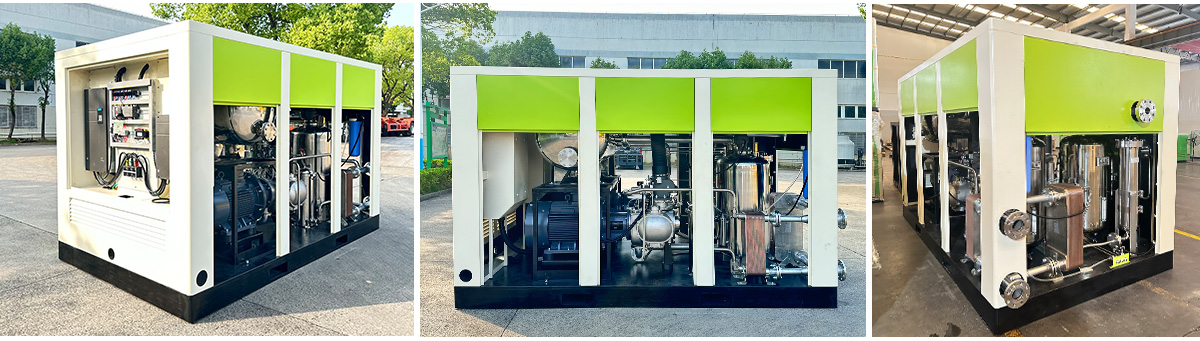
The Rocky RWH-250W two-stage water-injected screw compressor is built for 24/7 multi-cavity PET bottle blow-molding lines. It delivers 20 m3/min free air delivery at working pressure up to 40 bar, with 250 kW installed power split across two stages (90 kW + 160 kW). Instead of relying on filtration or rotor coating, it reaches ISO 8573-1 Class 0 by its working principle: purified water replaces lubricating oil inside the compression chamber for sealing, cooling and lubrication, so no oil enters the compression circuit at all.
The design responds to the four pain points described above:
· Genuine ISO 8573-1 Class 0 air at the point of use
Zero-oil compression removes the source of oil contamination instead of filtering it out afterwards. No dependency on aging coalescing elements and no rotor coating to peel. Mineral water, juice, CSD and rPET recycled bottle quality is protected, together with batch consistency and food-safety compliance.
· Variable-speed drive for fluctuating blow cycles
A permanent-magnet VFD matches motor speed to real-time blow-molder air demand, cutting the electricity cost of shift-based PET production. Users can also lower working pressure to 35 bar or 30 bar when the mould qualification allows it, gaining extra flow and reducing shaft power consumption.
· Simplified maintenance and less downtime
Routine service covers the water filter, air filter and water-treatment cartridge only. There is no oil sump, no oil change and no waste-oil disposal, which keeps maintenance time short and keeps the blowing line running.
· Stable continuous duty at plant level
Water-cooled two-stage near-isothermal compression keeps discharge temperature within a safe range and is rated for ambient temperatures up to 45 °C. IP55 motors with Class F insulation support continuous three-shift operation, and integrated systems can be configured so that one unit keeps partial production running while the other is serviced.
A Russian PET packaging manufacturer operates two high-speed stretch blow-molding lines for drinking-water and juice bottles. Its purchasing criteria were absolute oil-free blowing air, minimum production interruption caused by compressor maintenance, and verifiable performance before order confirmation.
The plant selected two RWH-250W 40-bar water-injected two-stage screw compressors configured as an integrated high-pressure air supply system. Before the order was placed, the customer’s technical team visited the Rocky factory, studied the compressor working principle, operated the controller, simulated fault diagnosis and witnessed a full-load performance test. After commissioning, the units have run stably through multi-shift bottle production with no oil-related bottle defect reported. The plant now benefits from a predictable maintenance schedule and a predictable long-term operating cost.
When comparing 25–40 bar compressors for a PET blow-molding workshop, initial purchase price is the weakest comparison point. Four checks decide the outcome over a five-to-ten-year horizon.
1. Verify where the oil-free claim comes from
Confirm whether Class 0 air quality comes from the compressor design itself or only from downstream filters. Class 0 must be verified at the blow-machine inlet, at the point of use, not only at the compressor outlet.
2. Match flow to the real blow cycle
Size the compressor by cavity count, bottle volume and cycle time, and calculate the simultaneous instantaneous blow-air demand before selecting the receiver volume.
3. Compare total cost of ownership
Compare power consumption, consumable cost, overhaul risk and downtime loss — not only the quotation value.
4. Check site and service fit
Check cooling-water availability, ambient temperature range, local grid voltage and frequency, and the response time of the service partner in your region.
Can a water-injected screw compressor really reach ISO 8573-1 Class 0 for PET blowing?
Yes. Water replaces oil inside the compression chamber for sealing and lubrication, so no oil exists in the compression circuit and the output air is oil-free by design rather than by post-filtration. Air quality should be tested at the blow-machine inlet, at the point of use, not only at the compressor outlet.
Can a 40-bar water-injected two-stage compressor run 24/7 for multi-cavity lines?
The RWH-250W is designed for heavy-duty continuous industrial operation. The water-cooled structure, IP55 high-efficiency motors and VFD soft-start system support round-the-clock PET bottle mass production.
Can we run at 30–35 bar instead of 40 bar to save energy?
Pressure must be approved by your blow-molder and mould qualification. Where the mould allows a lower blow pressure, reducing operating pressure increases free air delivery and cuts shaft power, which is a measurable saving for a beverage plant.
What routine maintenance does the compressor need in a PET workshop?
Periodic replacement of the water filter and air filter, plus regular water-quality inspection. No oil change and no waste-oil disposal are required, which keeps the maintenance workload low for the production team.
Oil-contaminated high-pressure blowing air is a silent quality killer in PET beverage bottle production, and downstream filters cannot remove the root cause. A water-injected two-stage screw compressor delivers true ISO 8573-1 Class 0 oil-free air by design, helping PET manufacturers lower bottle rejection rate, avoid food-safety risk, cut maintenance downtime and improve total cost of ownership across a 24-hour blow-molding operation.