


| Quantity: | |
|---|---|
250 kW 40 Bar Oil-Free Water-Injected Screw Compressor for PET Bottle Blowing
Class 0 oil-free air. Stable 40 bar at the blow valve. No oil to buy, change or dispose of.
| 40 bar working pressure | 250 kW motor | 20m³/min free air delivery | ISO 8573-1 Class 0 |This oil‑free rotary screw compressor operates with water‑based lubrication and is driven by a permanent‑magnet variable‑speed motor. In place of conventional oil, the system circulates purified water or a water‑based fluid, which ensures that the discharged air contains zero oil contamination. Such clean output makes the unit ideal for industries that demand exceptionally pure air. 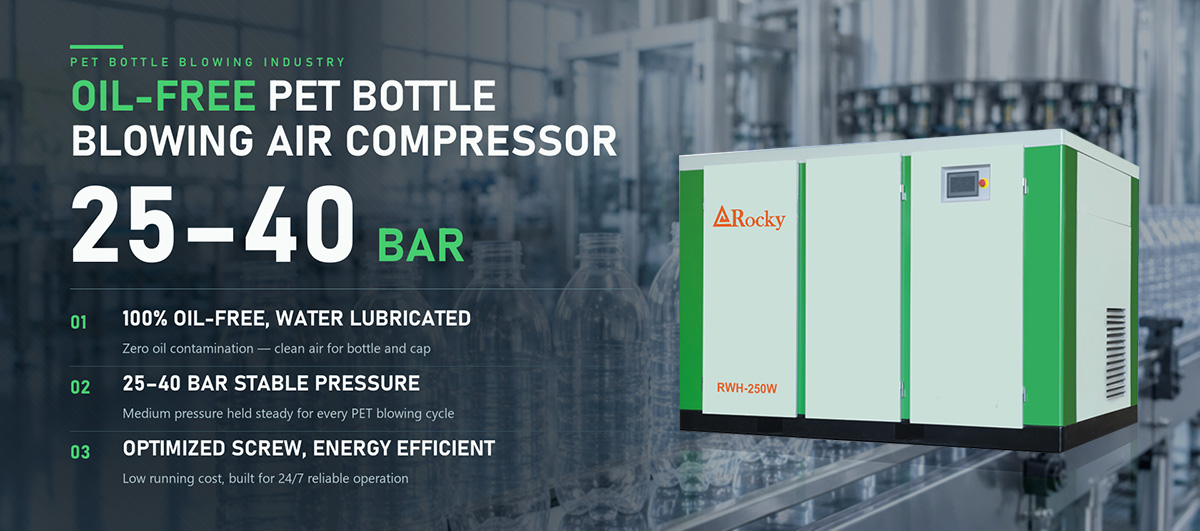
Oil-free, water-injected 40 bar air compressor for PET stretch blow molding.
20.0 m³/min (706 cfm) at 40 bar, 250 kW total (90 kW + 160 kW two-stage),
water-cooled, ISO 8573-1 Class 0 — no oil carry-over into the blow air.
Typical fit: multi-cavity PET lines for 0.5–1.5 L CSD and water bottles.
Lead time 25–35 working days · FAT before shipment · commissioning support available.
The RWH-250W is a two-stage, oil-free screw compressor that uses water instead of oil as the lubricant and sealant in the compression chamber. It delivers 20.0 m³/min at 40 bar from a 250 kW drive — the class of machine used on multi-cavity PET lines running 0.5–1.5 L bottles around the clock.
Because no oil enters the compression chamber, the air leaves the machine at ISO 8573-1 Class 0 for oil content — the class required by most food, beverage and pharmaceutical blow-molding specifications. Water is separated, filtered and recirculated inside the unit. The cooling circuit is separate from the process water and needs no oil top-up. The machine is built for continuous duty: IP55 motors, Class F insulation, direct drive, water cooling rated to 45 °C ambient, and a soft-start VFD that limits inrush on 380 V supplies. Water filter, air filter and water treatment cartridge are the routine service items; there is no oil circuit to maintain.
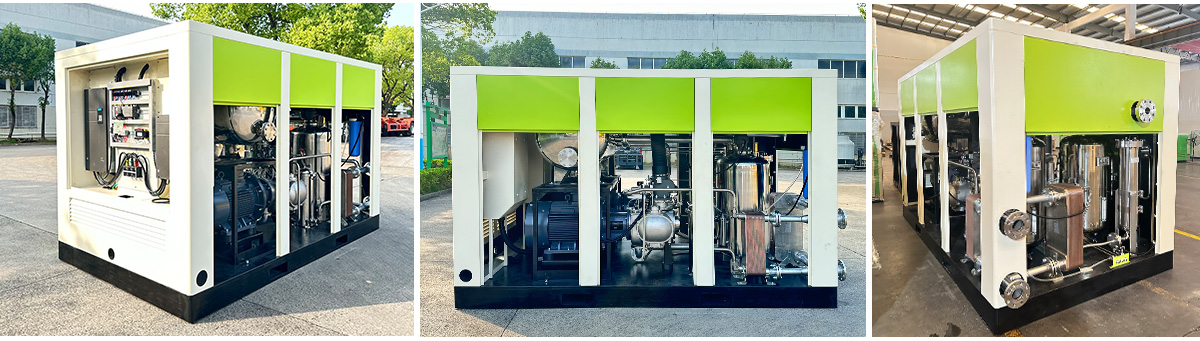
A single RWH-250W covers 20.0 m³/min at 40 bar with 250 kW installed power.
The table below is the complete specification, values are quoted at the stated conditions and follow ISO 1217 for free air delivery.
| Parameter | RWH-250W |
| Free Air Delivery | 20.0 m³/min |
| Working pressure | 40 bar |
| Motor power | 90 kW+160 kW |
| Motor efficiency (90 kW) | 96.70% |
| Motor efficiency (160 kW) | 96.80% |
| Motor Protection Class | IP55 |
| Insulation class | Class F |
| Power supply | 380V, 3-Phase, 50 Hz |
| Starting Method | Soft Start (VFD) |
| Transmission | Direct Drive |
| Discharge temperature | Cooling water inlet temperature + 15°C |
| Noise level | ≤ 82 dB(A) |
| Cooling method | Water cooling |
| Cooling water volume | 52 t/h |
| Cooling Water Connection | DN80 |
| Compressed Air Outlet | DN 65 |
| Dimensions (L × W × H) | 3600 × 2050 × 2250 mm |
| Net weight | 4200kg |
All values at 40 bar, 380 V / 50 Hz, cooling water 25 °C unless stated otherwise.
Free air delivery measured to ISO 1217. Other pressures (25 / 30 / 35 bar) and voltages on request — see the selection section below.
Blow pressure is set by the bottle design and the mould, not by the purchase budget.
The same machine produces more air and draws less shaft power as pressure drops, so the question is always: what is the lowest pressure your mould is qualified for?
40 bar — standard water and CSD bottles. Baseline for flow and power. Default for new lines.
35 bar — lightweight, thin-wall bottles with optimised moulds. Flow +3–5%, shaft power −5%.
30 bar — wide-mouth jars, some hot-fill lines, machines with low pre-blow demand. Flow +5–8%,
shaft power −9%. On high-volume lines this is the cheapest efficiency measure available: the saving is electricity, not machine price.
25 bar — only where the blowing machine and mould are qualified for it. Flow +8–12%, shaft power −13%. Never a purchasing decision on its own.
Lower pressure always requires confirmation: check wall thickness and burst pressure on bottle samples before committing, and confirm delivered flow and specific power for each pressure point against the ISO 1217 test report for the quoted model.
ISO 8573-1 Class 0 is the strictest oil-content class in the standard, and it is only meaningful when it is measured at the point of use — not at the compressor outlet. A water-injected compressor has no oil in the compression chamber, so the air leaves the machine oil-free by design rather than by filtration. That is the difference between
“Class 0 compressor” and “Class 0 system”: a coalescing filter downstream of an oil-lubricated machine can reach low oil carry-over, but it cannot guarantee zero, and it adds pressure drop and maintenance.
For blow molding this matters twice: oil in the blow air migrates to the bottle surface and, in food and beverage filling, becomes a contamination and taste risk. Specify Class 0 at the blowing machine inlet, and keep the dryer and filters sized for the full 20 m³/min.
At 40 bar the RWH-250W draws 250 kW; the annual electricity bill, not the purchase price,is the dominant cost over a ten-year life. Two levers matter:
Pressure — dropping from 40 to 30 bar cuts shaft power by roughly 9% at constant flow, because compression work follows ln(p₂/p₁). On a line running 6,000 h/year that is a measurable saving for a change that costs nothing in hardware.
Part-load control — the soft-start VFD matches motor speed to demand instead of loading and unloading at fixed speed. On lines with shift-based demand, the saving is typically larger than the pressure effect.
Maintenance for the oil-free water-lubricated screw air compressor primarily involves water and filters instead of oil. The routine service schedule consists of a water filter replacement (every 800–1,000 hours), an air filter replacement (every 2,000 hours), and a water treatment inspection (every 8 hours). Most importantly, this eco-friendly design requires no oil changes, no waste oil disposal, and no separator element replacements, ensuring maximum uptime and lower total cost of ownership.
In a two-stage PET blowing system the compressor is the high-pressure stage. It takes air from the plant header or from a pre-compression stage, raises it to 40 bar, and delivers it through a high-pressure receiver and dryer to the blowing machine.
What to plan around: a buffer vessel sized for the blow cycle (the mould draws a large instantaneous flow for a fraction of a second), a dryer rated for the full flow at 40 bar, and filtration that does not add more than 0.2 bar pressure drop. The air outlet is DN65 and the cooling water connection is DN80 at 52 t/h — both matter at the layout stage, not after the foundation is poured.
If the line runs several moulds, size the receiver and the header for the sum of the simultaneous blows, not the average consumption.
Standard lead time is 25–35 working days after specification confirmation and down payment. Machines ship in export-grade fumigation-free wooden cases; weight and dimensions are confirmed in the packing list before dispatch.
Before shipment we run a factory acceptance test and send the report with the machine: free air delivery, pressure hold, water circuit, control sequence.
Documentation includes the operation manual, electrical and P&ID drawings, and the spare-parts list — English as standard, Russian and other languages on request.
On site, commissioning support is available: installation supervision and start-up by our engineer, or remote guidance by video for standard stations. Operator training covers start-up, water treatment and the maintenance schedule.
• 30 bar version — same frame, higher delivered flow, for thin-wall and wide-mouth bottles.
• Two-stage PM VFD version — for lines with strongly variable demand.
• 40 bar piston compressor — for low-volume or intermittent production, lower capital cost.
• Complete PET air package — compressor, receiver, dryer, filters and controls on one skid.
Q1. What does 40 bar mean for PET blow molding, and when is 30 bar enough?
40 bar is the working pressure required by most stretch-blow moulds for 0.5–1.5 L CSD and water bottles: the pre-blow and final blow stages are set around it, and the mould is qualified for it. 30 bar is enough when the bottle is thin-walled or the mould is optimised for lower pressure —wide-mouth jars, some hot-fill designs, and machines with low pre-blow demand. At 30 bar the same machine delivers 5–8% more air and draws about 9% less shaft power. The decision is not a preference: it must be confirmed by the blowing machine's set pressure and by bottle sample tests (wall thickness, burst pressure).
Q2. Is a water-injected compressor really oil-free?
Yes — water replaces oil as the lubricant and sealant in the compression chamber, so the air leaves the machine without oil carry-over by design, not by filtration. The water is separated, filtered and recirculated inside the unit. The cooling circuit is separate and also oil-free. There is no oil sump, no oil filter and no oil separator element, which is also why maintenance is simpler than on an oil-lubricated machine. Air quality is specified as ISO 8573-1 Class 0 for oil content, measured at the point of use.
Q3. How much air does a PET line need, and how many cavities can this machine supply?
Air demand is set by three things: cavity count, bottle volume and cycle time. Each blow consumes a fixed volume of high-pressure air, so demand is essentially bottles per hour multiplied by air per bottle — which is why two lines with the same cavity count can differ by 30–40% depending on mould design. We therefore size from the mould maker's air consumption data rather than from a rule of thumb. The RWH-250W delivers 20.0 m³/min at 40 bar; send us cavity count, cycle time and bottle volume and we will confirm the flow against your mould data, including the receiver volume needed for simultaneous blows.
Q4. What maintenance does a 40 bar oil-free compressor need?
Water and filters, not oil. The routine work is: water filter replacement every 2,000 h, water quality check monthly, air filter every 2,000 h, and a check of the water treatment cartridge every 4,000 h. There is no oil change, no oil disposal and no separator element. Long intervals between water changes are the reason these machines are common on 24/7 beverage lines — the maintenance window is measured in hours per quarter, not per month.
Q5. What cooling water do I need?
52 t/h at DN80, with the discharge temperature running about 15 °C above the cooling water inlet temperature. Water quality should be soft, filtered and free of suspended solids; a closed circuit with a cooling tower or chiller both work. The machine is rated for 45 °C ambient, so in hot plants the water side is usually the constraint, not the air side. Confirm the actual inlet temperature on site before sizing the cooling tower.
Q6. What is the lead time, and what documents come with the shipment?
Standard lead time is 25–35 working days after specification confirmation and down payment. Shipping documents: invoice, packing list, contract and specification, HS codes, certificate of origin on request; conformity documents depending on destination. Machine documents: operation manual, electrical drawings, P&ID, spare-parts list — English as standard, Russian and other languages on request. A factory acceptance test report is issued before dispatch.
Q7. Can it run at 45 °C ambient, or in a cold climate?
The standard machine is rated to 45 °C ambient with water cooling. Above that, the cooling water circuit becomes the limiting factor and needs a larger tower or chiller. For cold climates we supply a winter package: low-temperature lubricant (the water circuit is the part that matters), crankcase and cabinet heaters, IP54 electricals, and a start-up procedure for sub-zero conditions. Minimum start-up temperature and warm-up sequence are stated in the manual for each model.
Q8. What is included in the price, and how do I get a quote?
The quotation covers the compressor with its controller, the water circuit and the base frame. Receiver, dryer, filters, piping and installation are quoted separately — because the right sizes depend on your line, not on a standard package. To quote accurately we need: required flow and pressure, bottle volume and cavity count, and the destination port. Send those three and we will return a specification with price and lead time within 1–2 working days.
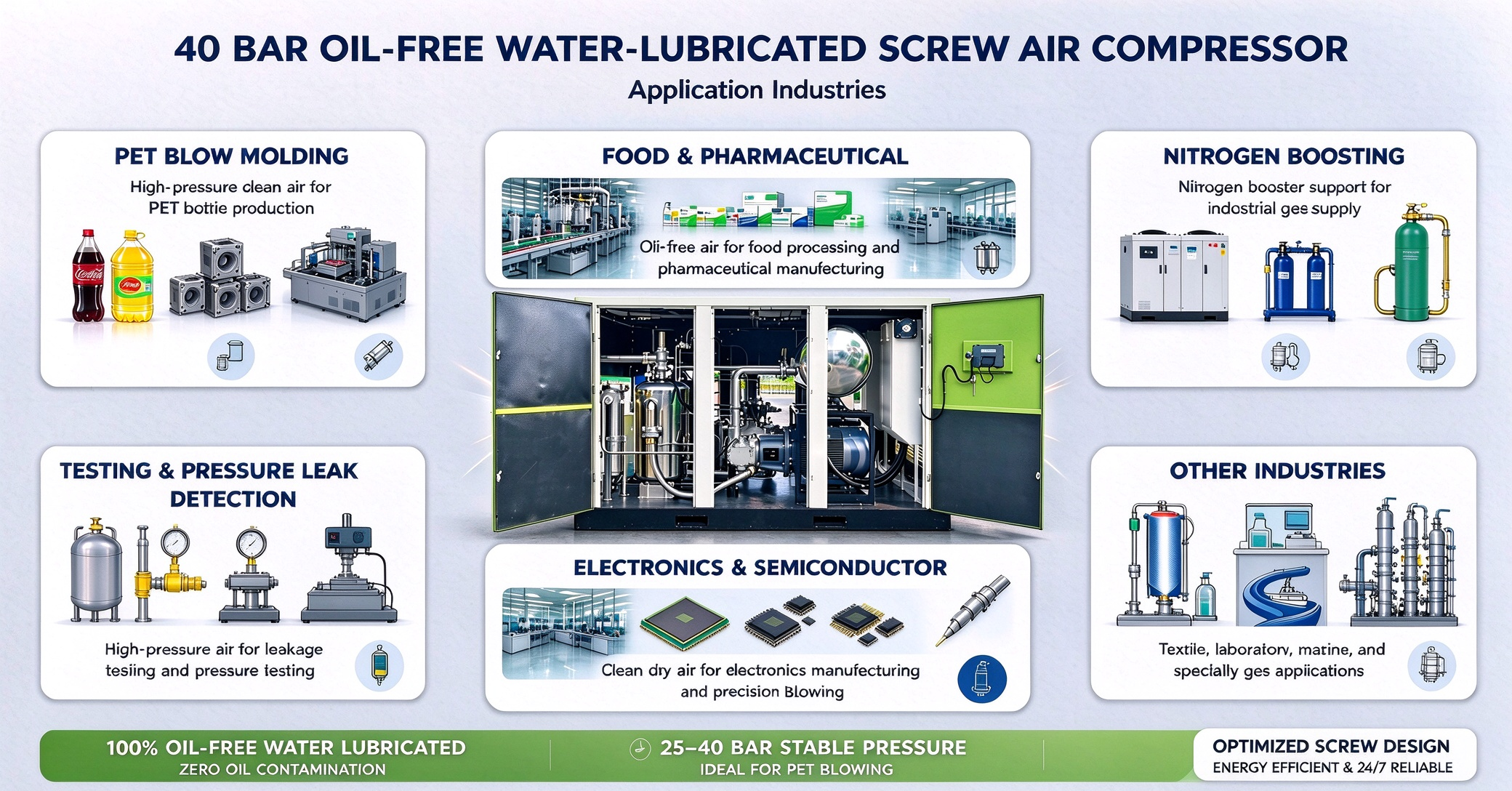
PET Container Blow‑Moulding – Delivers clean, high‑pressure air essential for shaping bottles.
Food & Beverage Sector – Guarantees fully oil‑free air that comes into direct contact with products.
Pharmaceutical Manufacturing – Supplies purified air for fermentation, tablet coating, and packaging lines.
Electronics & Semiconductor Fabrication – Provides contaminant‑free air for cleanroom environments.
High‑Pressure Nitrogen Boosting – Partners with nitrogen generators for laser cutting and electronic assembly.
Research & Analytical Laboratories – Offers quiet, stable, and oil‑free high‑pressure air for experiments and instruments.
2 × 40 bar units, PET packaging, Russia
A Russian PET packaging producer needed high-pressure air for two stretch blow-moulding lines, with three
conditions: absolutely oil-free air, continuous availability through maintenance, and a supplier whose engineering
could be verified before commitment.
Two 40 bar oil-free water-injected units were supplied as one integrated high-pressure system, so production
continues through maintenance or a stop on one machine. Before ordering, the customer's technical team spent
four days at the ROCKY factory: studying the working principle and site requirements, disassembling and rebuilding
key assemblies under supervision, operating the controller and diagnosing induced faults, and witnessing a test run
against the agreed specification. The order was confirmed shortly after their return.


