
Views: 0 Author: Site Editor Publish Time: 2025-12-11 Origin: Site
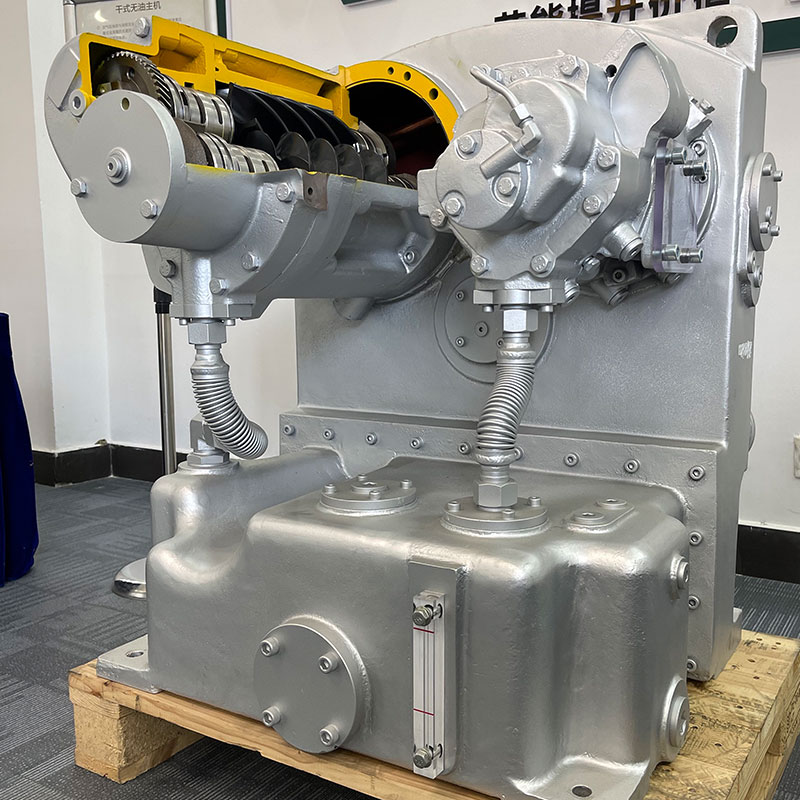
Within the realm of industrial compressed air generation, the rotary screw air compressor stands as a workhorse of modern manufacturing. While its functionality depends on a symphony of components—motors, coolers, controllers, and filters—the air end (or screw compressor block) is undeniably the cornerstone of the entire system. It is the very component where electrical energy is transformed into pneumatic power, defining the compressor's core capabilities in efficiency, reliability, and performance. Understanding its role is key to appreciating the technology.
The air end is not merely a component; it is the primary mover and compressor. Its function is elegantly mechanical:
The Working Principle: It houses a pair of precisely machined, helically grooved rotors (one male, one female) meshing within a close-tolerance chamber. As the rotors spin, air is trapped in the cavities between them and the housing wall.
The Compression Journey: The rotation progressively reduces the volume of these trapped air pockets from the inlet to the outlet side. This continuous reduction in volume mechanically increases the air pressure, achieving the fundamental goal of compression in a smooth, pulsation-free flow.
This process stands in stark contrast to the intermittent, high-vibration action of piston compressors, granting screw compressors their signature advantage of continuous, stable air delivery.
The design and condition of the air end directly govern the compressor's most critical economic metric: energy efficiency, which typically represents over 80% of a compressor's total lifetime cost.
Rotor Profile Geometry: Modern, advanced asymmetric profiles (like the 5+6 tooth design or proprietary evolved shapes) are engineered to minimize internal leakage ("blow-hole" loss), optimize sealing lines, and improve volumetric efficiency. This translates to more compressed air output per unit of electrical input (a lower specific power consumption).
Internal Clearances and Precision: Ultra-precise manufacturing ensures minimal operational clearances between the rotors and the housing. These tight tolerances prevent compressed air from leaking back to the inlet side, a major source of efficiency loss.
Built-in Pressure Ratio: The air end's internal volume ratio (Vi) is engineered to match target operating pressures. A correct match minimizes over- or under-compression losses, which waste energy.
An air compressor is a long-term investment, and the air end is its most critical durability component.
Robust Construction: High-strength, wear-resistant materials (such as coated alloy steel rotors) and large, high-capacity bearings are used to withstand constant mechanical and thermal stresses.
Direct Impact on Uptime: A well-maintained, high-quality air end can operate reliably for 40,000 to 100,000+ hours before a major overhaul. Its failure, conversely, means catastrophic downtime for the entire compressor.
System Stability: The smooth, continuous compression action imposes less stress on other system components (like couplings and motors) compared to pulsating technologies, contributing to overall system longevity.
The specifications of the air end define the fundamental output characteristics of the compressor:
Flow Rate (Capacity): The size, speed, and profile of the rotors primarily determine the maximum volume of air (cfm or m³/min) the compressor can deliver.
Pressure Capability: The structural integrity, bearing design, and internal ratio of the air end set the feasible maximum working pressure (e.g., 7, 10, 13, or 15 bar).
Air Quality (For Oil-Injected Models): In oil-flooded screw compressors, the air end's design is integral to the oil injection and separation process. Efficient mixing and separation within the system start here, impacting the downstream oil carry-over levels.
The inherent characteristics of the rotary screw air end enable sophisticated compressor designs:
Variable Speed Drive (VSD) Compatibility: The continuous compression action allows for smooth capacity control across a wide speed range. The air end's efficiency profile across this range is crucial for realizing the full energy-saving potential of a VSD system.
Packaging Flexibility: Its compact, cylindrical shape and continuous flow output make it ideal for integration into complete, space-efficient compressor packages, from basic fixed-speed units to complex central systems.
In essence, the screw air end is the defining technological heart of a rotary screw air compressor. It is not a passive part but the active agent of energy conversion. Its design dictates the system's efficiency, its construction ensures its durability, and its performance parameters bound the compressor's capabilities. While auxiliary components ensure clean, cool, and controlled air delivery, it is within the precisely machined chambers of the air end that the fundamental act of reliable, efficient compression takes place. Therefore, selecting a compressor with a robust, well-designed air end is the single most important decision in securing a productive and cost-effective compressed air supply.


