
Views: 0 Author: Site Editor Publish Time: 2026-04-20 Origin: Site
A PSA Nitrogen Generator is an essential solution for industries that require a constant, reliable supply of nitrogen. This technology uses Pressure Swing Adsorption (PSA) to separate nitrogen from air, offering an efficient, on-site method of nitrogen generation. Nitrogen is widely used across pharmaceuticals, food packaging, electronics, and many other industries. Traditional supply methods—such as purchasing from external suppliers or using bulky storage tanks—are often expensive and inefficient.
A PSA Nitrogen Generator addresses these challenges by producing nitrogen directly at the point of use, eliminating external suppliers and reducing operational costs. This article explains how PSA Nitrogen Generators work, their key components, and the advantages over other methods.
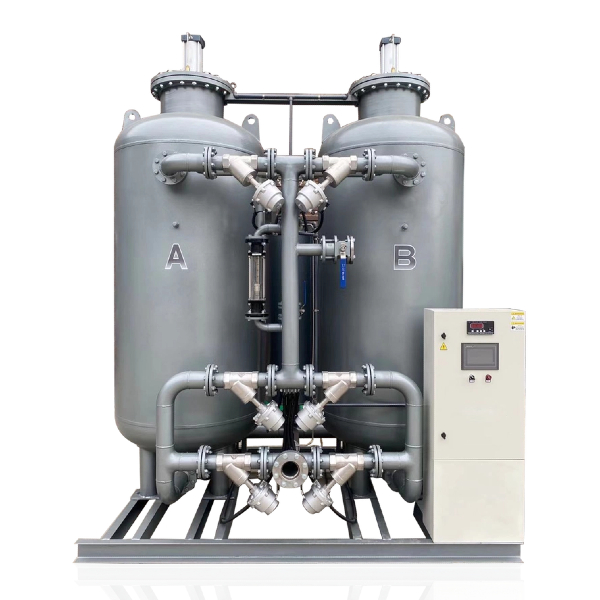
A PSA Nitrogen Generator uses Pressure Swing Adsorption technology to separate nitrogen from compressed air. The process relies on adsorbent materials—typically carbon molecular sieve (CMS)—which adsorb oxygen and other gases while allowing nitrogen to pass through, producing high-purity nitrogen.
Compressor – Compresses ambient air.
Adsorption beds – Contain CMS to adsorb oxygen and other impurities.
Control valves – Regulate air flow and pressure swings.
Nitrogen outlet – Delivers purified nitrogen.
Ambient air is drawn in and compressed to a typical pressure of 4–7 bar. It is then filtered to remove dust, moisture, and oils, which could damage the adsorbent material.
Compressed, filtered air enters the adsorption beds containing CMS. The CMS selectively adsorbs oxygen, carbon dioxide, and moisture, while nitrogen (less readily adsorbed) passes through and is directed to the outlet. This produces a high-purity nitrogen stream.
Note: CMS adsorbs impurities based on molecular size and affinity. Oxygen molecules are smaller and more easily adsorbed than nitrogen.
After a period of adsorption, the CMS becomes saturated with oxygen and other gases. The pressure in the bed is then reduced, causing the adsorbed gases to desorb and be vented. Once regenerated, the pressure is increased again, and the next adsorption cycle begins. Two or more beds operate in parallel to ensure continuous nitrogen production.
The nitrogen that passes through the CMS can achieve purity levels from 95% to 99.999%, depending on system design and operating parameters. It is either delivered directly to the point of use or stored in a receiver tank for later consumption.
Step | Description |
1. Air Compression | Ambient air compressed to 4–7 bar |
2. Filtration | Removal of moisture, dust, and oil |
3. Adsorption | CMS adsorbs O₂, CO₂, moisture; N₂ passes through |
4. Pressure Swing | Pressure reduced to regenerate CMS |
5. Nitrogen Storage | Purified N₂ stored or used directly |
On-site generation – No reliance on external suppliers, deliveries, or cylinder storage.
Cost-effective – Lower long-term operational costs compared to purchased nitrogen.
Energy efficient – Uses moderate pressures and temperatures; consumes less energy than cryogenic distillation.
Low maintenance – Requires only periodic filter changes and CMS replacement every 3–5 years.
Industry | Use |
Pharmaceutical | High-purity N₂ for oxygen-sensitive manufacturing |
Food packaging | Modified atmosphere packaging (MAP) to extend shelf life |
Electronics | Inert atmosphere for semiconductor and PCB production |
Chemical / Petrochemical | Inerting, purging, blanketing |
Feature | PSA Nitrogen Generator | Cryogenic Nitrogen Generation |
Energy consumption | Low | High |
Nitrogen purity | 95% – 99.999% (adjustable) | Typically >99.99% (but fixed) |
Initial investment | Lower | Higher |
Operation flexibility | On demand, variable flow | Best for large, constant flows |
Maintenance | Low | High |
Correction: PSA systems can achieve very high purity (up to 99.999%) for many applications. Cryogenic systems are economical only at very large scales.
A PSA Nitrogen Generator provides a reliable, cost-effective, and energy-efficient solution for on-site nitrogen production. It eliminates the need for external suppliers, reduces operational costs, and offers flexible purity and flow control. Industries such as pharmaceuticals, food packaging, electronics, and chemicals greatly benefit from this technology.
At Shanghai Rocky Machinery Co., Ltd., we specialize in high-quality PSA Nitrogen Generators tailored to your specific needs. Contact us to learn how we can optimize your nitrogen generation process.
1. What is the difference between a PSA Nitrogen Generator and a traditional nitrogen tank?
A PSA generator produces nitrogen on-site continuously, while a tank requires refilling from an external supplier.
2. Can a PSA Nitrogen Generator produce 99.999% pure nitrogen?
Yes, PSA systems can achieve purity from 95% up to 99.999% depending on design and operating parameters.
3. How much energy does a PSA Nitrogen Generator consume?
PSA systems are energy-efficient, consuming mainly the energy needed for air compression. They use significantly less power than cryogenic distillation for small to medium flow rates.
4. Is a PSA Nitrogen Generator easy to maintain?
Yes. Routine maintenance includes cleaning or replacing intake filters, checking valves, and replacing the carbon molecular sieve every 3–5 years.
5. What industries commonly use PSA Nitrogen Generators?
Pharmaceuticals, food packaging, electronics, chemicals, oil & gas, and laboratories.
6. How long does a PSA Nitrogen Generator typically last?
With proper maintenance, the system can last over 10 years. CMS replacement is needed every 3–5 years.


