
Views: 0 Author: Site Editor Publish Time: 2026-07-20 Origin: Site
In highly regulated manufacturing environments, microscopic aerosolized oil in a compressed air stream triggers catastrophic product recalls, equipment damage, and compliance failures. Facility managers face a strict decision. You can rely on multi-stage filtration to achieve technically oil-free air, which carries inherent breakthrough risks. Alternatively, you can invest in inherently oil-free generation technologies. For operations where contamination equals immediate financial or reputational loss, upgrading to a Class 0 certified system is a risk-mitigation necessity. This guide evaluates the technical realities of ISO 8573-1 Class 0 standards. We assess the mechanical advantages of water lubrication and define exactly which industries must adopt this technology to protect their production lines.
ISO 8573-1 Class 0 is a use-case specific standard, not a guarantee of "absolute zero" contamination; it mandates purity levels stricter than Class 1, customized to the facility's specific baseline requirements.
Filtration carries inherent risk: "Technically oil-free" systems rely on filters that can fail under high temperatures or pressure drops, whereas inherently oil-free compressors eliminate oil from the compression chamber entirely.
Water-lubricated systems offer specific thermodynamic advantages: Compared to dry screw compressors, water-lubricated models provide superior cooling, near-isothermal compression, and tighter sealing, resulting in higher energy efficiency.
High-risk industries mandate inherent purity: Food and beverage, pharmaceuticals, laboratories, chemical processing, semiconductors, and advanced textiles require true oil-free air to maintain product integrity and regulatory compliance.
Purity boundaries matter:Class 0 certification governs industrial air quality; it does not automatically qualify air as medical-grade breathing air or biologically sterile without specialized downstream purification.
Defining exact purity requirements for sensitive applications is essential to avoid over-engineering or under-specifying the air system. The ISO 8573-1 standard provides clear classifications for compressed air purity. A common myth surrounds the concept of absolute zero contamination. Class 0 does not mean zero contamination exists in the ambient air stream. Instead, it means the compressor adds oil at a concentration so low that it is agreed between the supplier and the user as being below the measurable limit for Class 1. In practice, Class 0 typically requires oil concentrations well below the Class 1 limit of 0.01 mg/m³, often approaching undetectable levels.
You must also understand the critical boundary of Class 0. According to CAGI (Compressed Air and Gas Institute) standards, Class 0 is designed specifically for industrial applications. It does not address or guarantee sterile air or human breathing air. Those applications require separate medical-grade filtration and rigorous validation protocols.
Relying solely on filtration to achieve Class 1 (technically oil-free) air introduces significant risks. Oil-injected compressors paired with coalescing and carbon filters have distinct failure points:
Temperature spikes can cause oil vapor to bypass filter media entirely.
Filter degradation under pressure drops leads to rapid downstream contamination.
Maintenance delays allow saturated carbon filters to release trapped hydrocarbons back into the airstream.
Risk profiles differ between direct-contact and non-contact applications:
Direct contact (air touches the product or packaging) – demands strict Class 0 validation.
Non-contact (pneumatic instrumentation or general manufacturing) – Class 0 air is primarily used to prevent downstream component deterioration and extend equipment lifespan.
 |  |  |
When generating Class 0 air, facilities evaluate different solution categories. The primary technologies include dry screw and water-lubricated systems. Understanding the mechanism of action is critical for plant engineers.
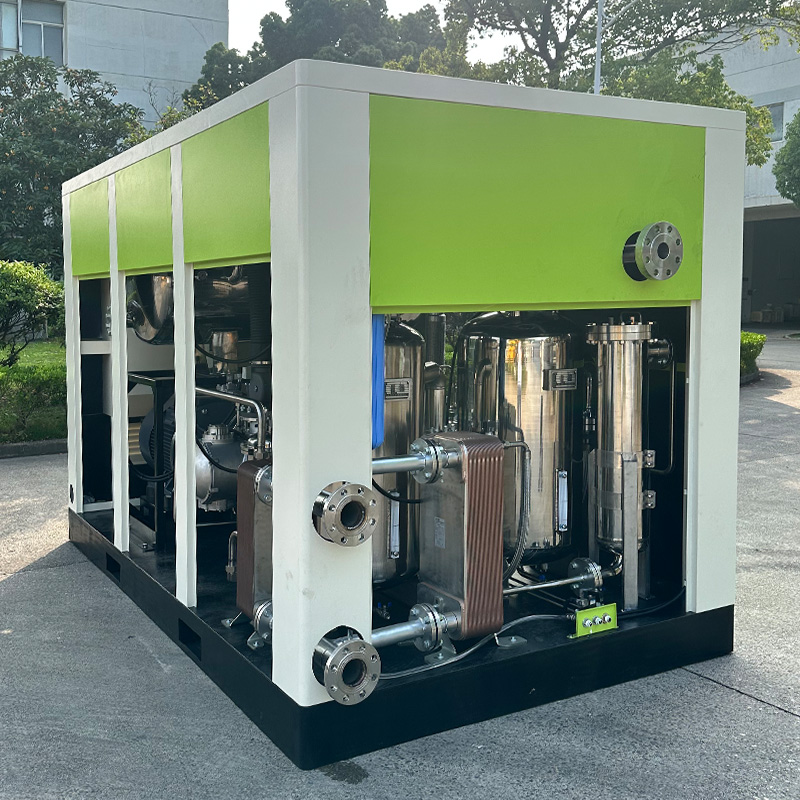
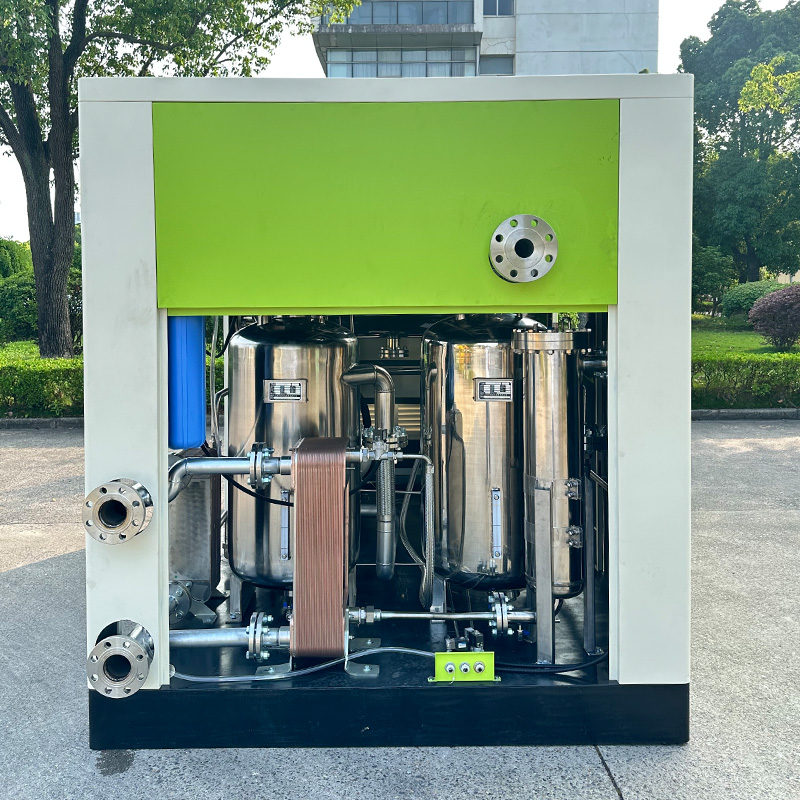
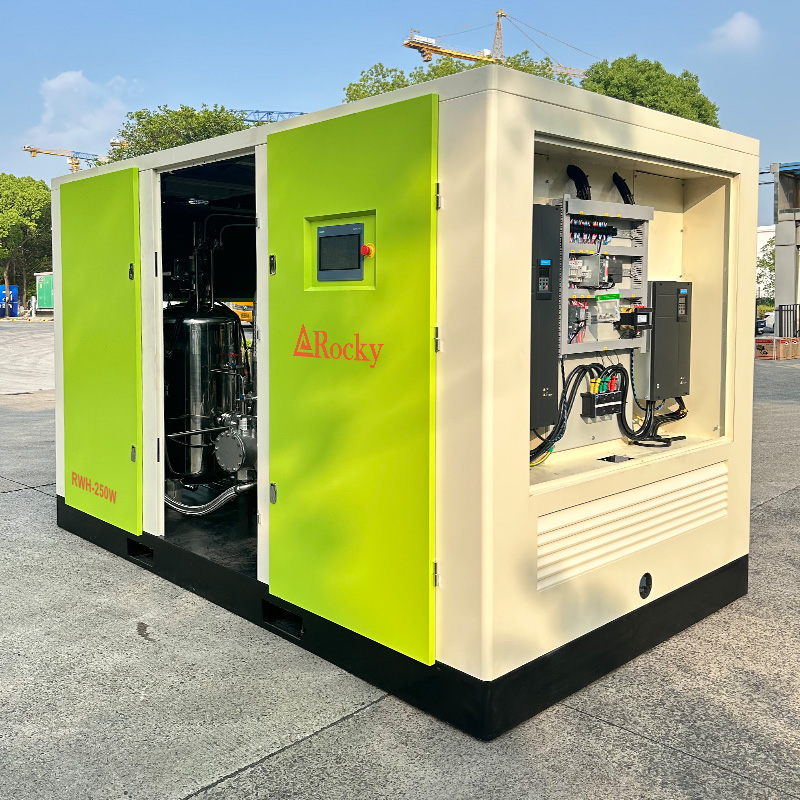
A water lubricated screw air compressor injects purified water directly into the compression chamber. This water simultaneously acts as:
Coolant – absorbing heat of compression,
Sealant – filling rotor clearances to minimize internal leakage,
Lubricant – protecting the rotors without any hydrocarbon oil.
This design completely isolates the compression process from hydrocarbon lubricants.
Comparing dry screw and water-lubricated technologies reveals distinct operational differences:
Dry screws typically run at elevated temperatures and may require two-stage configurations to manage heat, though modern single-stage designs with advanced cooling are available. They rely on tight rotor tolerances and high rotational speeds to minimize air slippage.
Water-lubricated systems achieve near-isothermal compression because the injected water absorbs heat immediately. This improves volumetric efficiency and reduces specific energy consumption—though the exact savings depend on pressure, flow, and ambient conditions.
Environmental and operational synergies are also significant:
An oil-free water-lubricated compressor eliminates the hazard of oily condensate disposal. The discharged water is free of oil contamination, simplifying environmental compliance and removing the need for expensive oil-water separators.
Technical Comparison: Dry Screw vs. Water-Lubricated Compression (Typical Characteristics) | ||
Operational Metric | Dry Screw Technology | Water-Lubricated Technology |
Cooling Mechanism | Air or separate water jacket cooling | Direct water injection into the airend |
Operating Temperature | High (may require two stages to prevent overheating) | Low (near-isothermal compression profile) |
Sealing Efficiency | Lower (relies on extremely tight rotor tolerances) | Higher (water physically seals rotor gaps) |
Condensate Management | Requires handling of ambient airborne contaminants | Oil-free water discharge simplifies disposal |
Rotational Speed | High RPM to minimize internal air slippage | Lower RPM due to effective water sealing |
Mapping the technological capabilities of water-lubricated systems to specific industry requirements reveals why certain sectors mandate this technology. We evaluate these dimensions by connecting mechanical features to strict compliance outcomes.
Food and beverage facilities face strict FDA and FSMA compliance requirements for direct and indirect product contact. A food-grade oil-free air compressor is necessary for packaging, bottling, mixing, and sorting. Pneumatic conveying of bulk ingredients (flour, sugar) also relies on this air. Trace oil can alter taste and odor profiles instantly and promote microbial growth inside piping networks, leading to health risks and large-scale recalls.
Pharmaceutical manufacturing adheres to USP standards and cleanroom protocols. Class 0 air is critical for tablet coating, fermentation, and blister packaging. Oil aerosols can alter chemical compositions or contaminate sterile environments. In analytical labs, trace hydrocarbon vapors interfere with sensitive tests like gas chromatography and mass spectrometry—even a few ppm can skew baseline readings.
Class 0 air acts as safe instrument air for control valves, actuators, and process controls. Oil deposits can cause valves to stick or fail, triggering shutdowns. In volatile refinery environments, trace oil vapor represents an ignition and combustion risk when reactive gases are present. Inherently oil-free compression removes this fire hazard.
Ultra-cleanrooms require air free of micro-contaminants. Even trace oil vapor causes defects on silicon wafers, leading to yield losses and failed circuit layers—the financial impact of contaminated batches is substantial. Cleanroom HVAC and pick-and-place robots demand zero particulate or hydrocarbon load.
Compressed air is used for air-jet weaving, spinning, texturising, winding, and dyeing. Oil droplets block dye absorption and stain fabrics permanently, resulting in rejected batches. High-speed looms consume large air volumes, making the energy efficiency of water-lubricated systems particularly beneficial.
Robotic painting, powder coating, and pneumatic tools require pristine air. Oil vapor causes fisheyes, blistering, and adhesion failures on high-value components—rework is costly. Dedicated oil-free air ensures consistent atomisation and finish quality.
Analyzing long-term operational implications is essential for facility planning. Consider CapEx vs. OpEx:
True oil-free systems typically have higher initial purchase prices than oil-injected models.
However, operational savings offset this investment—you eliminate filter replacement costs, oil disposal fees, and pressure-drop energy penalties. As a general industry estimate, every 1 bar (14.5 psi) of pressure drop across a saturated filter bank increases energy consumption by roughly 7% (actual values depend on system design).
Energy efficiency gains are notable: water sealing reduces internal slippage, delivering more CFM per kW than many dry screw alternatives. Near-isothermal compression consumes less energy to reach target pressure.
Environmental and ESG metrics improve—you eliminate waste oil disposal and reduce the carbon footprint through better efficiency. Upgrading to a water-lubricated Class 0 system supports clean manufacturing initiatives and ensures long-term compliance.
Installing and maintaining a water-lubricated system presents practical engineering challenges that must be addressed proactively.
These systems require high-purity water (typically reverse osmosis or demineralised) to prevent scaling and corrosion inside the precision-engineered airend. Standard tap water contains minerals that will damage internal components and shorten compressor life. Plan for integrated or external water treatment during installation.
There is a distinct risk of freezing in cold environments. Mitigation strategies include heated enclosures, climate-controlled compressor rooms, or trace heating on external water supply lines.
Never pair a Class 0 compressor with legacy black iron piping. We strongly recommend stainless steel or aluminium piping to prevent rust and particulate contamination downstream.
Install dedicated RO water lines directly to the compressor room.
Implement freeze-protection trace heating on external water supply lines.
Replace all black iron distribution headers with smooth-bore aluminium piping.
Schedule quarterly water quality tests to verify RO membrane performance
While water-lubricated technology offers clear advantages, it is not without constraints:
Higher initial infrastructure cost – RO water treatment adds capital expense.
Sensitive to water quality – even temporary deviations can accelerate wear.
Complexity of freeze protection – adds installation and maintenance overhead.
Not always necessary – for non-critical applications, oil-injected with filtration may suffice at lower cost.
A thorough cost-benefit analysis should weigh these factors against the risk profile of your specific production environment.
To make an informed decision:
Conduct a comprehensive compressed air audit to identify current vulnerabilities in your filtration setup.
Test your existing air quality against ISO 8573-1 standards using third-party laboratory analysis.
Consult a pneumatic engineer to specify the correct CFM for your peak demand and evaluate your facility's water treatment capabilities.
Upgrade legacy black iron piping to stainless steel or aluminium before installing the new compressor.
Adopting an oil-free water-lubricated screw compressor is a strategic investment in production reliability, regulatory compliance, and long-term operational efficiency—but only when matched to the right application and supported by proper system design.
A: It is a compressor certified under ISO 8573-1 to meet a use-case specific purity limit that is stricter than Class 1 (oil concentration < 0.01 mg/m³). The exact limit is agreed between the user and the manufacturer—typically set so low that oil addition is undetectable.
A: It injects purified water directly into the compression chamber. The water acts as the lubricant, sealant, and coolant—completely isolating the rotors from hydrocarbon oils.
A: No. Class 0 guarantees that the compressor introduces no oil (or oil below the agreed limit). However, ambient intake air may still contain dust, moisture, or background hydrocarbons. Standard particulate and desiccant filtration are still required to remove these environmental contaminants.
A: While coalescing filters can theoretically reduce oil to low levels, they are not fail-safe. For direct food contact applications, we strongly recommend inherently oil-free generation (Class 0) to eliminate the risk of filter breakthrough, which can lead to contamination and regulatory non-compliance. For non-contact applications, filters may be acceptable but require rigorous maintenance schedules.
A: RO or demineralised water prevents mineral deposits, scaling, and corrosion inside the precision-engineered airend. Standard tap water contains dissolved minerals that would quickly damage internal components and reduce lifespan.
A: No. Class 0 is an industrial standard focused strictly on oil content. Sterile air or medical breathing air requires completely different validation protocols, including specialised biological filtration and carbon monoxide monitoring systems.
Ready to evaluate a Class 0 water-lubricated compressor for your facility?
Contact our engineering team for a free TCO assessment tailored to your production line.


