
Views: 0 Author: Site Editor Publish Time: 2026-05-21 Origin: Site
Traditional gas procurement leaves industrial facilities exposed to endless logistical headaches. You constantly face volatile pricing, unpredictable supply chain bottlenecks, and severe safety hazards. Buying bulk liquid or high-pressure cylinders binds your operation to ongoing rental fees. You also remain strictly dependent on third-party delivery schedules. Shifting from renting gas to generating it on-site provides complete supply independence. A PSA gas generator transforms your operation by producing commercial-grade gas exactly when you need it. You move from an unpredictable operational expense to a reliable capital asset. This article provides facility managers, procurement leads, and engineers a clear evaluation framework. You will learn how to assess if on-site generation fits your operational demands. We will help you navigate your specific purity requirements objectively so you can make an informed, data-driven upgrade decision.
Predictable ROI: On-site PSA generation typically yields a full return on investment within 12 to 24 months for continuous 24/7 operations (18–36 months for typical industrial applications) by eliminating recurring delivery, rental, and hazmat fees
Enhanced Safety: Replaces highly pressurized (200–300 bar) cylinders and cryogenic liquid (-196°C) handling with localized production operating at a safe 4–8 bar.
Uninterrupted Supply: Eliminates third-party supply chain delays, producing commercial-grade gas on-demand, 24/7.
Scalable Purity: Capable of achieving highly tailored purity levels—up to 99.9995% for nitrogen and 95% for oxygen—matching specific industrial specifications.
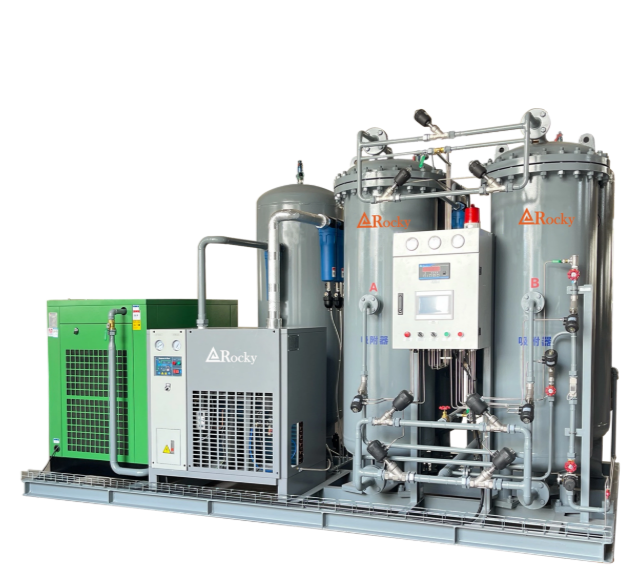
To understand the massive advantages of on-site production, we must look at how the technology actually works. The system relies on a continuous twin-tower cycle operating under pressure. These two parallel towers alternate their functions to separate air molecules efficiently. They typically switch roles every 60 seconds. The physical process follows a strict internal sequence: pressurization, adsorption, depressurization, and purging.
While the first tower pressurizes and traps unwanted gases, the second depressurizes to regenerate itself. The trapped gases exhaust safely into the surrounding atmosphere. This constant, rhythmic swing ensures you always receive a steady, uninterrupted flow of pure gas.
The true secret lies in the specialized adsorption media packed inside these tall towers. Different industrial gases require completely different materials to achieve optimal separation.
For nitrogen separation: Engineers use Carbon Molecular Sieves (CMS). The CMS material resembles tiny, porous carbon pellets. As compressed air pushes through the tower, the CMS traps smaller oxygen molecules. It then lets the slightly larger nitrogen molecules pass through smoothly.
For oxygen separation: Systems rely on Zeolite Molecular Sieves (ZMC). Zeolite acts as a highly selective molecular sponge. It effectively captures nitrogen molecules under pressure, leaving high-purity oxygen for your downstream processes.
Let us compare the main gas delivery and generation methods available to modern facilities today:
Technology Type | Typical Purity Range | Ideal Operational Environment | Notable Drawbacks |
|---|---|---|---|
Membrane Generator | 95% – 99.9% | High-vibration, mobile setups, outdoors | Cannot reach ultra-high purity levels. Lower energy efficiency. |
Liquid Gas Delivery | Up to 99.999% | Facilities lacking adequate power infrastructure | Constant boil-off losses, transit delays, restrictive contracts. |
PSA Gas Generator | Up to 99.9995% | Stationary, continuous high-flow requirements | Requires upfront capital investment and facility floor space. *Ultra-high purity (e.g., 99.999%) may come at reduced flow rates and increased energy consumption; consult technical specifications for your specific application.* |
Membrane technology works well for rugged environments because it lacks moving parts. However, they cannot reach the extreme purity levels many precision industries demand. Liquid delivery provides high purity but introduces major vulnerabilities to your facility. You face unavoidable boil-off losses during storage. You also suffer through unpredictable transit delays and restrictive vendor contracts. By contrast, PSA remains the industry standard. It handles stationary, high-purity, and continuous-flow requirements effortlessly.
Producing your own gas on-site creates immediate and massive financial benefits. Generating gas locally drops your unit cost to a tiny fraction of delivered gas.
For example, under continuous operation, nitrogen production cost can fall as low as approximately $0.20–0.30 per 100 cubic feet, primarily covering the electricity for the air compressor. (Total operational cost varies by local electricity rates, purity level, and site conditions.)
...
Replacing bulk liquid delivery contracts or cylinder supply significantly reduces long-term operational expenses. Moving away from rigid bulk liquid contracts often cuts overall gas production costs by 50% to 80%. Your finance team will notice the cash flow improvement almost immediately. Imagine a manufacturing plant spending thousands of dollars monthly on liquid deliveries. By switching to on-site generation, they slash those specific bills down to basic electricity costs.
When you run continuous operations, the payback period becomes highly predictable. Most industrial facilities see a full return on investment within 9 to 24 months. You essentially redirect the money previously wasted on rentals toward owning a hard asset. After the equipment pays for itself, the gas you generate is practically free.
Traditional liquid gas delivery introduces severe physical dangers to your factory floor. Cryogenic liquid sits at an extreme -196°C. Mishandling it causes instant and severe frostbite to workers. You also face explosive expansion risks if the liquid rapidly warms into gas inside closed spaces. Traditional delivery requires strict safety protocols and specialized personal protective equipment. Producing your own gas happens at normal ambient temperatures. You eradicate these cryogenic hazards entirely.
Pressure reduction represents another massive safety upgrade for your personnel. High-pressure cylinders store gas at a terrifying 200 to 300 bar. A damaged valve can turn a heavy metal cylinder into a deadly projectile. A PSA system operates at a standard, highly safe 4 to 8 bar. You remove a major liability from your work environment.
Beyond physical safety, you gain ultimate supply chain immunity. Delivered gas relies heavily on external logistics networks. Weather delays, driver shortages, and geopolitical issues often disrupt local delivery schedules. On-site generation guarantees zero downtime for your critical manufacturing processes. You manufacture gas 24/7 as long as your facility has power.
Finally, this transition delivers massive environmental and compliance wins. Heavy diesel delivery trucks no longer enter your facility every single week. Removing these vehicles drastically reduces your Scope 3 carbon emissions. You run a safer, greener, and much more resilient operation.
Different industries require highly specific gas profiles to maintain product quality and safety. PSA systems scale seamlessly to meet these exact industrial specifications. They replace bulk delivery by offering custom solutions for distinct chemical needs.
Deploying a psa nitrogen gas generator gives you access to ultra-high purity gas. These systems reliably achieve tailored purity levels up to 99.9995%. We see this precise technology transforming several critical sectors globally:
Electronics Manufacturing: Facilities use pure nitrogen for wave soldering processes. The inert gas prevents oxidation, ensuring perfect and reliable electrical joints on circuit boards.
Food and Beverage: Modified Atmosphere Packaging (MAP) relies on nitrogen to displace oxygen inside wrappers. This technique prevents spoilage and significantly extends product shelf life.
Metallurgy: Manufacturers use metallurgical blanketing during intense heat treatments. The nitrogen prevents hydrogen embrittlement and stops surface oxidation on metal parts.
Oil and Gas: Technicians rely on high-purity nitrogen for safe pipeline purging. It safely eliminates internal combustion risks before maintenance teams begin their work.
Deploying psa oxygen gas generators provides a steady, reliable stream of concentrated oxygen. These generators typically deliver commercial purity levels between 90% and 95%. They serve as the critical backbone for numerous demanding applications:
Healthcare Services: Medical centers and field hospitals use them constantly. They replace critical cylinder logistics, ensuring vulnerable patients always receive life-saving oxygen without delay.
Aquaculture: High-density fish farming requires highly precise environmental controls. Oxygen generators maintain stable dissolved oxygen levels in the water to keep aquatic life healthy.
Metal Fabrication: Industrial cutting and welding processes require steady, uninterrupted oxygen. An on-site supply drastically boosts operational efficiency on the bustling fabrication floor.
Before purchasing a new system, you must understand the real-world physical requirements. A PSA unit does not operate entirely alone in your facility. The complete infrastructure requires an accompanying air compressor, an air dryer, and buffer tanks. Buyers must carefully assess their available facility floor space before installation. Fortunately, manufacturers now offer highly compact and skid-mounted options to fit much tighter factory layouts.
We must also address basic maintenance truths to ensure your success. These systems are highly reliable, but they are absolutely not "zero-maintenance" machines. Proper upkeep actively protects your substantial capital investment. You must strictly adhere to scheduled air filtration changes. If you skip this crucial step, oil or moisture can permanently contaminate the CMS or ZMC media. Once contaminated, the media loses its separation ability entirely.
You also need to consistently monitor internal pressure drops and daily flow metrics. Tracking these numbers ensures the system maintains greater than 90% operational efficiency over time.
Maintenance Requirement | Standard Frequency | Operational Impact |
|---|---|---|
Air Filter Replacement | Every 6-12 Months | Blocks oil and moisture from permanently ruining the molecular sieves. |
Pressure Drop Checks | Weekly | Confirms switching valves operate correctly and efficiency remains high. |
Buffer Tank Inspection | Annually | Maintains safe gas storage pressure and identifies early structural wear. |
Air Dryer Service | Annually | Guarantees feed air remains completely dry before entering adsorption towers. |
When you provide pristine feed air and follow routine preventative maintenance, longevity is exceptional. The core adsorption towers and their internal media can reliably operate for 15 to 20 years or more. This incredible equipment lifespan highlights exactly why switching to on-site generation makes strong business sense.
Choosing to install a PSA gas generator fundamentally changes your operational strategy. You shift away from treating gas as a recurring consumable expense. Instead, you own your gas production as a highly strategic utility asset. This transition stabilizes your monthly budget and secures your production lines against outside disruptions.
Decision-makers should take three concrete steps right now. First, audit your facility's past 12 months of bulk gas invoices. Second, calculate your exact purity requirements and continuous flow needs accurately. Third, request a custom ROI audit from a reputable equipment manufacturer.
Stop relying on unpredictable third-party logistics and volatile market pricing. Contact a system architect today for a comprehensive site assessment. You can also use an online ROI calculator to visualize your immediate potential savings and optimize your future facility operations.
A: A high-quality system can reliably operate for 15 to 20 years or more. To achieve this incredible longevity, you must keep the inlet air completely dry and oil-free. You accomplish this by strictly following scheduled filter replacements and conducting routine preventative maintenance.
A: Yes, it easily adapts to changing requirements. Buffer tanks store compressed gas to handle sudden flow spikes perfectly. Additionally, modern control panels modulate the air compressor's energy use during low-demand periods. This ensures your facility remains highly energy-efficient at all times.
A: The transition is surprisingly straightforward. A properly sized PSA system simply connects directly to your existing downstream facility piping. Installation happens quickly, and technicians often complete the final setup with minimal workflow disruption or downtime to your current manufacturing operations.


