
Views: 0 Author: Site Editor Publish Time: 2026-05-11 Origin: Site
Uncontrolled airborne particulate threatens worker health across modern manufacturing facilities. It accelerates machinery wear and exposes businesses to severe OSHA and EPA compliance violations. Managing this hazard requires robust, specialized infrastructure.
Many buyers mistakenly equate these industrial filtration systems to oversized shop vacuums. This misconception leads to dangerous procurement errors. Standard vacuums rely on high static pressure to move tiny volumes of air. Conversely, an Industrial Dust Collector is engineered differently. It moves massive volumes of air at a lower pressure. It captures suspended particles safely across continuous, heavy-duty operations.
This guide explains the precise working mechanisms behind industrial air filtration. Facility managers and safety engineers face complex environmental challenges. You will learn how to evaluate the right technology, select optimal filter media, and understand automated cleaning mechanisms. We outline the technical workflows required to match equipment to your specific operational profiles.
The 5-Step Lifecycle: Every effective industrial dust collection system relies on a continuous loop of Capture, Convey, Filter, Clean, and Discharge.
Mechanism Matches Material: There is no universal solution; cartridge collectors excel in general manufacturing, baghouses handle abrasive/high-temperature loads, and wet scrubbers are critical for highly combustible dust.
Continuous Operation: Modern systems utilize automated pulse-jet cleaning to clear filter media without requiring facility downtime.
Compliance is Non-Negotiable: System selection must account for NFPA standards regarding explosive dust, requiring specific deflagration or suppression features.
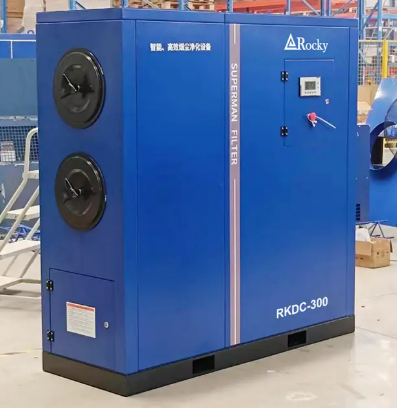
Demystifying the operational workflow is the first step in system evaluation. Every industrial filtration unit operates on a baseline engineering concept. The system must successfully move contaminated air through a physical sequence. If any step fails, the entire system loses efficiency. We break down this continuous loop into five distinct phases.
The process begins exactly where the particulate is generated. Effective systems utilize engineered hoods or flexible collection arms. They grab dust before it disperses into the facility environment.
Evaluation consideration: Maintaining the correct capture velocity is critical.
Common mistake: If suction is too low at the source, ambient dust escapes into the facility.
Best practice: Position hoods as close to the generation point as physically possible. This maximizes capture efficiency and reduces overall energy demand.
Once captured, the contaminated air must travel to the filtration unit. The system relies on industrial fans to pull air through the ducting. Manufacturers typically use radial-blade or backward-inclined centrifugal fans. They resist wear and handle particulate-laden airstreams effectively.
Ducting design is a strict engineering discipline. The network must minimize air friction. Experienced engineers avoid absolute 90-degree angles. Sudden turns cause turbulence. Turbulence drops air velocity rapidly. They opt instead for dual 45-degree sweeps or spiral ducting. This prevents heavy particulate drop-out and dangerous pipe clogs.
The contaminated air eventually reaches the main collector housing. The air hits a baffle or expands into a larger chamber. This causes a sudden drop in air velocity. Heavy particles lose momentum. They fall directly into a lower hopper. Often, a cyclone pre-separator aids this initial sorting phase.
The remaining fine particulate travels upward. Specialized filter media traps these microscopic contaminants. The air passes through the media pores. The clean air then exits the system. It vents safely outdoors or returns to the facility floor.
Filters inevitably clog over time. Clogged filters restrict airflow and ruin system suction. Industrial units feature integrated self-cleaning mechanisms. They dislodge accumulated dust cakes from the filters automatically.
This automated purging ensures the system maintains steady airflow. Manual intervention remains largely unnecessary during regular shifts. Operators can maintain production schedules without stopping to shake out dirty filters.
Dislodged dust falls continuously during the cleaning cycle. It collects in a sealed hopper. Facilities use rotary valve systems or sealed drum lids to manage the waste.
Proper discharge mechanisms are vital for regulatory compliance. They allow safe disposal without reintroducing dangerous dust back into the ambient air. You must empty these bins on a strict schedule.
Choosing the right Dust collector type depends heavily on your material. There is no universal hardware solution. You must match the mechanical capabilities of the equipment to your specific business use case. We categorize the four major system types below.
System Type | Core Mechanism | Primary Filter Media | Ideal Application |
|---|---|---|---|
Cartridge | High surface area filtration, pulse-cleaning | Pleated non-woven fabric | General manufacturing, welding fumes |
Baghouse | High-CFM depth filtration, durable bags | Cylindrical woven fabric | Mining, foundries, high temps |
Wet Scrubber | Centrifugal liquid mixing and sludge separation | Water or specialized liquid | Combustible dust, sticky particulate |
Cyclone | Vortex physics and centrifugal force | No primary fine filter (Inertial) | Bulk waste pre-separation |
Cartridge units represent the most common modern filtration solution. They utilize pleated, non-woven fabric filters. These filters often feature a polyester and cellulose blend. Premium versions use specialized nanofiber coatings.
They pack a massive surface area into a highly compact footprint. This makes them highly efficient for fine particulate. They are the ideal application for general manufacturing. You will see them handling welding fumes, laser and plasma cutting operations, and general woodworking. They perform best for fine, free-flowing dust.
Baghouses are the heavy-duty workhorses of industrial filtration. They pass high-CFM (Cubic Feet per Minute) dirty air through long, cylindrical woven fabric bags. Unlike pleated cartridges, these bags endure intense physical abuse.
They are the ideal application for heavy industrial environments. Facilities in mining, foundries, and cement production rely on them. They are highly capable of handling extreme temperatures. They manage heavy dust loading seamlessly. Abrasive or sticky materials quickly blind a standard cartridge filter. Baghouses survive these harsh conditions effortlessly.
Wet scrubbers abandon dry filtration media entirely. They inject water or specialized chemical liquids directly into the contaminated airstream. They utilize intense centrifugal force to mix liquid droplets with the dust.
The particles absorb the liquid. They become heavy enough to separate out as a thick sludge. They are the ideal application for handling highly combustible materials. Aluminum and titanium dust require this wet encapsulation. They also excel at handling extremely sticky particulate or high-humidity airstreams.
Implementation Risk: Wet scrubbers require rigorous, diligent maintenance. You must actively keep the liquid’s dust concentration below 5 percent. If the sludge thickens beyond this threshold, the system loses all filtration efficiency safely.
Cyclones rely strictly on aerodynamics rather than physical barriers. They use vortex physics and centrifugal force inside a conical chamber. The spinning air pushes heavy particles outward against the walls. Gravity drags them down into a collection bin.
They typically target particulate larger than 20 microns. They are rarely used as standalone filtration. Facilities position them ahead of cartridge or baghouse systems. They filter out the bulk waste first. This drastically extends the life of the primary fine filters downstream.
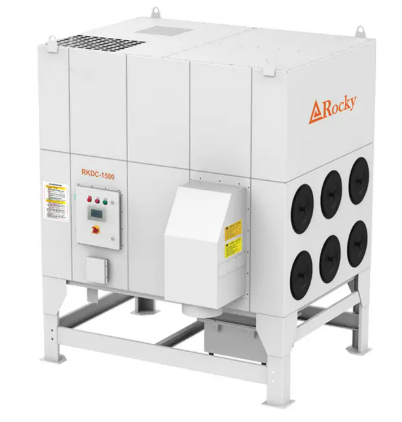
A filtration system must clean itself to remain functional. Evaluating how systems maintain efficiency helps facility managers avoid costly production shutdowns. We outline the primary mechanisms that clear dust from the media.
Pulse-jet technology dominates the modern market. The system utilizes automated electronic timers or sensors. It shoots short, high-pressure bursts of compressed air backwards through the center of the filter.
This rapid burst creates a mechanical shockwave. The shockwave travels down the media and shatters the accumulated dust cake on the exterior.
Business Value: It allows for continuous, online operation. The main exhaust fan never has to shut down during the cleaning sequence.
Production Impact: Facilities experience zero production interruptions.
Older or highly specialized systems use mechanical shakers. A motorized physical linkage vibrates the filter bags aggressively. This physical shaking dislodges the hardened dust.
Unlike pulse-jet units, shaker systems require compartmentalized offline cleaning. The airflow to that specific compartment must stop completely during the shake cycle. Alternatively, the entire system must undergo a scheduled shutdown.
Business Value: They remain highly effective for remote facilities without access to reliable compressed air.
Production Impact: Remote mining sites or facilities handling aggressively clumping dust still favor this robust, low-tech reliability.
Cleaning frequency dictates system longevity. Facilities must choose between timed cycles and intelligent sensors.
Continuous cleaning fires pulses on a set timer, regardless of dust load. This wastes compressed air. It also physically stresses the fabric unnecessarily.
Advanced evaluation criteria favor on-demand systems. They use pressure-drop sensors to monitor airflow resistance. They trigger cleaning sequences only when the dust cake restricts airflow beyond a specific threshold. This dramatically reduces wear and tear on the filter media compared to timed cycles.
Guiding the procurement process requires specific facility data. You cannot buy industrial filtration off the shelf. You must shortlist vendors based on strict environmental variables. We outline the exact requirements you must define.
You must understand exactly what you are capturing. The physical and chemical properties of your material dictate the engineering.
Ask these critical questions during your evaluation:
Is the material combustible?
Does it possess sticky or hygroscopic (water-absorbing) traits?
Is the particulate highly abrasive?
Is the material toxic?
Hardwood dust, for example, contains known carcinogens. Toxic profiles demand specialized HEPA-level ambient air filtration as a secondary defense layer. If the dust is highly abrasive, you need specialized drop-out boxes and heavy-duty baghouse fabrics to prevent blowouts. This dust profile determines whether you require a wet scrubber, a standard cartridge unit, or a specialized reinforced baghouse.
System selection involves strict legal obligations. An industrial unit must meet rigorous OSHA and NFPA standards. Ignoring these regulations invites catastrophic facility risks.
Combustible dust requires specialized mitigation hardware. When handling explosive materials, the system must be engineered with explosion venting. These vents direct blast forces safely outdoors. Chemical suppression systems extinguish sparks milliseconds before they ignite the primary filter housing.
Furthermore, you must install rotary airlock valves at the discharge points. These valves maintain an airtight seal while dropping waste. They actively prevent a localized deflagration from traveling backward through the ductwork and into the main facility floor.
Understanding how industrial filtration works is foundational to long-term facility safety. Moving high volumes of air efficiently requires precise engineering. Separating hazardous particulate via specialized media or liquid ensures environmental compliance. Relying on automated self-cleaning mechanisms guarantees continuous, uninterrupted production.
Dust collection is never a plug-and-play purchase. Relying on guesswork leads to severe safety hazards and rapid equipment failure. Take these action-oriented next steps for your facility:
Conduct a comprehensive facility audit to measure your required total CFM.
Commission a professional laboratory test to assess your specific dust toxicity and combustibility.
Collaborate with an engineering specialist to design a ductwork layout optimized for minimal air resistance.
By mapping your precise operational variables, you protect your workforce, extend equipment life, and maintain strict regulatory standing.
A: No. Standard HVAC filters are designed for low-concentration environmental dust. Industrial particulate will blind an HVAC filter almost immediately. This rapid clogging will damage the blowers and recirculate hazardous air back into the building. Dedicated dust collection relies on heavy-duty filtration media and automated self-cleaning mechanisms designed specifically for high particulate loads.
A: A shop vacuum operates on high negative pressure (suction) but moves a very low volume of air. This makes it suitable for direct-port tool cleaning. A dust collector operates at lower pressure but moves up to 10x the volume of air (high CFM). This allows it to capture suspended airborne particles across a wider area and through extensive, complex duct networks.
A: While highly dependent on operational hours and dust type, standard cartridge filters in an automated pulse-jet system typically require replacement every 6 to 12 months. Implementing a cyclone pre-separator can significantly extend this lifespan. The cyclone removes heavy debris before it reaches the fine filter media, reducing the overall physical burden on the primary cartridges.


