
Views: 0 Author: Site Editor Publish Time: 2026-05-11 Origin: Site
Traditional reliance on delivered industrial gas introduces significant vulnerabilities. Facilities depending on cylinders, dewars, or bulk liquids often face volatile pricing models. They also encounter unexpected supply chain disruptions and serious safety risks during handling. These hidden logistical hurdles drain facility budgets unnecessarily. They also endanger operational continuity during critical production shifts. A PSA Gas Generator offers a strategic shift from recurring operational expenditure to a predictable, on-site capital asset. It empowers operators to take full control of their gas utility. This article provides a comprehensive technical and commercial evaluation of PSA systems. We explore the commercial benefits and physical realities of adopting this technology. Facility managers and engineers will learn how to align on-site generation with their specific ROI requirements. You will discover actionable steps to evaluate footprint, purity, and flow rate dynamics before issuing an RFP.
Economic Shift: Reduces gas costs to fractions of a cent per cubic foot, typically yielding a 9–24 month ROI.
Supply Security: Guarantees 24/7 on-demand gas without logistical delays or cylinder run-outs.
Uncompromised Purity: Capable of achieving up to 99.9995% purity, suitable for stringent electronics, pharmaceutical, and metallurgical applications.
Implementation Reality: Requires strict inlet air quality management (refrigerated drying) to protect the molecular sieves from moisture-induced failure.
Most facility managers evaluate gas expenses by looking at the base price per cubic foot. This narrow view ignores a massive layer of operational bloat. Third-party gas delivery operates on a complex pricing structure designed to maximize supplier profits. You must absorb hazmat delivery fees, fuel surcharges, and environmental compliance taxes. Suppliers also lock facilities into rigid cylinder rental agreements. These contracts often mandate minimum monthly purchases regardless of your actual consumption.
Traditional cylinders also introduce a severe inefficiency known as the "residual waste" problem. Facilities pay for entirely full canisters. However, physics dictates you can never use 100% of the purchased volume. Your internal production equipment requires a minimum intake pressure to function. Once the cylinder pressure drops below this threshold, the gas stops flowing. You inevitably return canisters holding 10% to 15% of their original volume. Over a fiscal year, this residual waste represents thousands of dollars evaporating into thin air.
On-site generation fundamentally changes this dynamic. It establishes absolute supply chain independence. A power outage at a regional gas plant or a severe weather event can halt delivery trucks. When trucks stop, your production line stops. On-site generation treats gas supply as a controlled, internal utility. You produce exactly what you need, exactly when you need it. You eliminate downtime caused by late deliveries and remove external logistical dependencies entirely.
Safety liabilities drop drastically when you transition away from delivered gas. Bulk liquid gas requires extreme storage conditions. Liquid nitrogen rests at a cryogenic -196°C. Liquid oxygen presents intense fire acceleration risks. Operators handle cylinders pressurized between 2900 and 4350 psi. These heavy metal tubes act like unguided missiles if a valve breaks. Removing these cryogenic and high-pressure storage vessels protects your workforce. It significantly reduces manual handling injuries, frostbite risks, and catastrophic leak potential.
Beyond safety, on-site systems provide unmatched operational scalability. Liquid gas tanks constantly absorb ambient heat. This heat causes the liquid to boil off into vapor. During weekend shutdowns or off-peak shifts, this vapor builds pressure and safely vents into the atmosphere. You lose purchased inventory simply because the clock is ticking. PSA equipment operates differently. You turn it on when shifts begin. You turn it off when shifts end. The system dynamically adjusts flow rates and purity levels to match exact production schedules. You suffer zero off-hour boil-off losses.
This efficiency directly supports sustainability and Environmental, Social, and Governance (ESG) metrics. Industrial gas distillation requires deeply energy-intensive cryogenic fractional facilities. Suppliers then load heavy-duty diesel trucks to distribute the product across vast regions. On-site generation severs this entire carbon footprint. You separate atmospheric air locally using standard electrical power. This shift drastically lowers Scope 3 emissions and aligns modern manufacturing floors with aggressive green initiatives.
Risk Factor | Delivered Bulk / Cylinders | On-Site PSA Generator |
|---|---|---|
Storage Pressure | 2900 - 4350 psi (Highly volatile) | Typically under 150 psi (Safe utility level) |
Temperature Hazards | Cryogenic (-196°C), severe frostbite risk | Ambient temperature operation |
Inventory Loss | Continuous off-hour boil-off venting | Zero loss; generates strictly on-demand |
Carbon Footprint | High (Distillation + heavy truck transport) | Low (Local air separation only) |
Different industrial processes demand vastly different atmospheric conditions. Matching your purity needs to the right equipment prevents costly over-engineering. For example, a psa nitrogen gas generator excels in ultra-high purity applications. Semiconductor manufacturing, wave soldering, and metallurgy depend on these systems. In metallurgical applications, removing trace oxygen prevents hydrogen embrittlement. It ensures metal components retain their structural integrity. Even a minor purity drop in electronics assembly creates oxidation, ruining expensive circuit boards.
Conversely, intensive oxidation and combustion processes require the opposite approach. A facility will deploy psa oxygen gas generators for medical scaling, wastewater treatment, and laser cutting. Wastewater plants use high-purity oxygen to feed aerobic bacteria, breaking down organic matter rapidly. Metal fabricators use it to create intensely hot, focused cutting beams. Both scenarios require a highly consistent, tailored gas output.
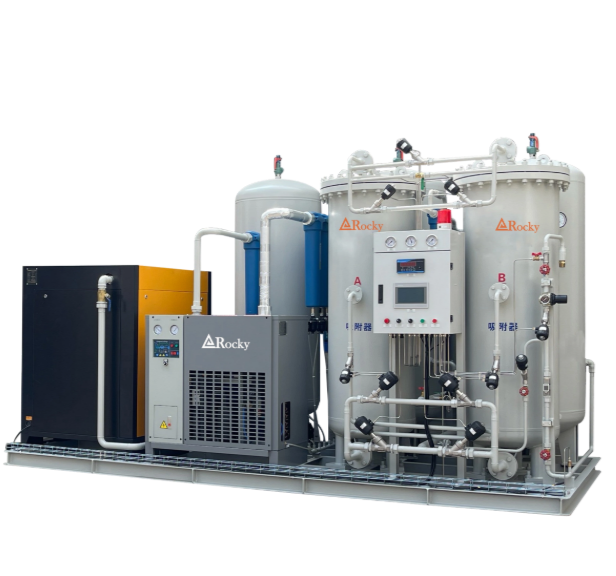
You must understand the core physical reality governing PSA technology: purity and flow rate hold an inverse relationship. A PSA machine uses dual towers filled with a specialized medium. Nitrogen systems use a Carbon Molecular Sieve (CMS). Oxygen systems use zeolite. These porous materials trap unwanted molecules under high pressure.
If you push air through the towers rapidly, you maximize your total output volume. However, the rapid flow gives the CMS less time to capture unwanted oxygen molecules. Your flow rate spikes, but your purity drops. If you slow the airflow down, the CMS has ample contact time to adsorb impurities. You achieve ultra-high purity (up to 99.9995%), but your production speed decreases significantly. Engineers must carefully calculate their baseline purity minimums to size the generator correctly. Buying a machine rated for 99.999% purity when your process only requires 98% will force you to purchase an unnecessarily large, expensive compressor to compensate for the flow rate reduction.
Choosing between PSA and Membrane technology dictates your installation footprint, maintenance schedule, and final gas quality. Both separate air, but they utilize entirely different mechanics.
When to Choose PSA:
PSA stands as the authoritative choice when ultra-high purity and high flow rates are non-negotiable. If your process requires 99.5% to 99.9995% purity, you must select PSA. These systems rely on robust carbon or zeolite beds. When properly maintained, a PSA system boasts an expected lifecycle exceeding 20 years. The dual-tower design ensures continuous gas delivery. While one tower actively adsorbs impurities, the other depressurizes to vent them, seamlessly alternating every few minutes.
When Membrane is Sufficient:
Membrane technology works beautifully for less demanding environments. It uses bundles of porous polymer fibers to filter gases passively. If your application only requires 95% to 99% purity, membrane systems offer a simplified alternative. They contain no moving parts. This makes them highly resistant to severe vibrations found on offshore oil rigs or mobile mining equipment. Membrane units also tolerate slightly wetter inlet air better than CMS beds do.
Footprint and Weight Constraints:
Your facility layout plays a major role in technology selection. PSA systems demand a dedicated installation footprint. They require dual steel adsorption towers, a complex network of switching valves, separate buffer tanks, and extensive pre-filtration assemblies. They carry significant weight. Membrane generators remain highly modular. You can mount them on walls or tuck them into tight spaces. You must verify floor load capacities and ceiling heights before committing to a heavy-duty PSA setup.
Treating a PSA system as a "plug-and-play" appliance leads to catastrophic equipment failure. These robust systems require rigorous upfront design. You must protect the core capital investment by strictly managing your inlet air quality.
The primary vulnerability of any PSA setup involves moisture. Standard air compressors generate immense amounts of liquid water and oil aerosols during operation. You must install a high-quality refrigerated air dryer upstream from the generator. If moisture bypasses your filtration and hits the Carbon Molecular Sieve, disaster strikes. Water coats the microscopic pores of the CMS. It prevents the sieve from adsorbing target molecules. This creates "channeling," where air carves permanent bypass pathways through the bed. Once channeling occurs, adsorption efficiency plummets. You cannot simply dry the bed out. Moisture-induced failure necessitates a highly intensive, expensive total system rebuild. You must tear down the towers and replace the entire CMS batch.
Proper maintenance prevents channeling and ensures the system operates above 90% efficiency for decades. The maintenance burden remains highly predictable. You must replace coalescing and particulate filter elements annually. Technicians should regularly monitor pressure gauges and flow analytics. A sudden pressure drop indicates a failing valve or clogged filter. You must also maintain the upstream air compressor diligently. A failing compressor starves the generator of adequate feed air, dropping your final production volume.
Determining your payback period involves straightforward math. Facility managers routinely see a complete return on their capital investment within 9 to 24 months. You calculate this by comparing current expenses against new operational inputs.
Current External Costs: Monthly Gas Purchase Price + Hazmat Delivery Fees + Cylinder/Tank Rental Contracts.
New Internal Costs: Capital Equipment Amortization + Electricity Cost of Running the Air Compressor + Annual Filter Replacement Parts.
Once the initial capital amortizes, your gas costs plummet to fractions of a cent per cubic foot. You only pay for the electricity required to compress the atmospheric air.
Transitioning away from delivered gas fundamentally optimizes industrial production. A PSA system replaces unpredictable delivery logistics and volatile pricing with a stable, on-site utility. While the technology requires upfront capital and strict adherence to moisture control, the long-term economic benefits remain undeniable. You eliminate off-hour boil-off, erase residual cylinder waste, and protect your workforce from extreme handling hazards.
To move forward, we recommend initiating a comprehensive internal gas audit immediately. Track your exact flow rates in SCFH or LPM. Identify the absolute minimum purity levels your manufacturing process tolerates. Over-specifying purity drastically increases initial equipment costs. Finally, secure an accurate footprint layout of your utility room. Measure ceiling heights and assess ventilation capacity. Gathering these precise metrics ensures you solicit accurate proposals when issuing your final equipment RFP.
A: A well-maintained PSA gas generator easily lasts 15 to 20 years. The core Carbon Molecular Sieve (CMS) media degrades incredibly slowly under ideal conditions. To achieve this lifespan, operators must strictly enforce inlet air filtration. Keeping liquid water, oil vapor, and particulates out of the adsorption towers prevents premature media failure.
A: Yes, dedicated compressors are highly recommended. While you can tap into existing plant air, doing so introduces severe risks. Plant air systems experience frequent pressure fluctuations as other machines cycle on and off. A dedicated compressor ensures the generator receives the consistent pressure and flow volume required to maintain steady gas purity.
A: No. PSA technology operates through simple physical separation, not chemical reaction. It takes standard atmospheric air and separates its components. A nitrogen generator captures oxygen and safely vents it back into the ambient room environment. There are no toxic emissions, hazardous chemical wastes, or environmental penalties associated with the process.
A: Facilities typically achieve a complete payback within 9 to 24 months. The exact timeline depends heavily on your local electricity rates and the severity of your current supplier contracts. Once the initial equipment cost amortizes, your ongoing operational expense drops strictly to the electricity used by the air compressor.


