
Views: 0 Author: Site Editor Publish Time: 2026-08-26 Origin: Site
Industrial aeration and pneumatic conveying can account for a substantial share of a plant's electricity use. The blower therefore affects much more than airflow: it influences operating cost, process stability, workplace noise, maintenance workload, and future expansion capacity. Roots blowers have served industrial plants reliably for decades, while oil-free screw blowers are increasingly considered for continuous-duty systems that need better specific power and wider control capability.
Neither technology is automatically the best choice. A successful selection starts with measured flow, normal and maximum discharge pressure, inlet conditions, operating hours, demand variation, and the required air-purity class. This guide compares Roots and oil-free screw blowers from the mechanical, operational, and installation perspectives, then explains when the required pressure moves an application out of the blower range and into the oil-free air-compressor category.
Compression principle: A Roots blower transports a fixed air volume and equalizes pressure at the discharge port. A screw blower progressively compresses the trapped air inside the air end before discharge.
Energy performance: Internal compression can lower pressure-equalization losses, especially in continuous-duty applications with a moderate pressure ratio. Actual savings must be calculated from package input power at the required operating points.
Air purity: Both technologies can use an oil-free compression chamber. If ISO 8573-1 Class 0 is required, verify the certificate and test scope for the exact machine configuration.
Application fit: Roots blowers often remain attractive for simple, lower-pressure, intermittent, or budget-sensitive duties. Oil-free screw blowers are often favored for continuous operation, variable demand, higher blower pressures, and processes that value smooth airflow.
Blower vs. compressor: A blower is intended for relatively low-pressure, high-volume air. Applications requiring several bar of plant air or tens of bar for PET blowing need an oil-free air compressor instead.
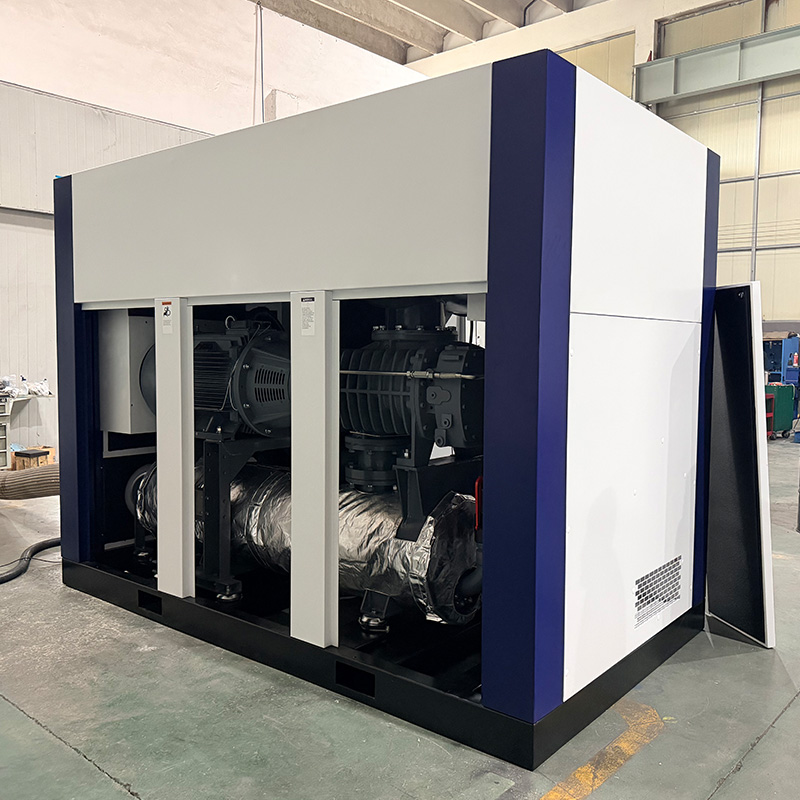 | 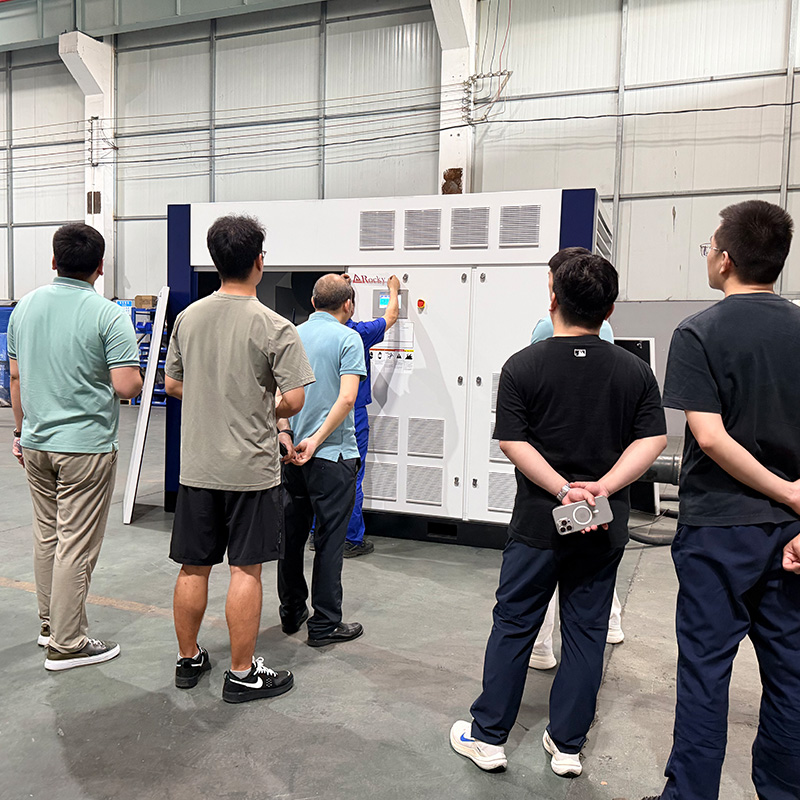 | 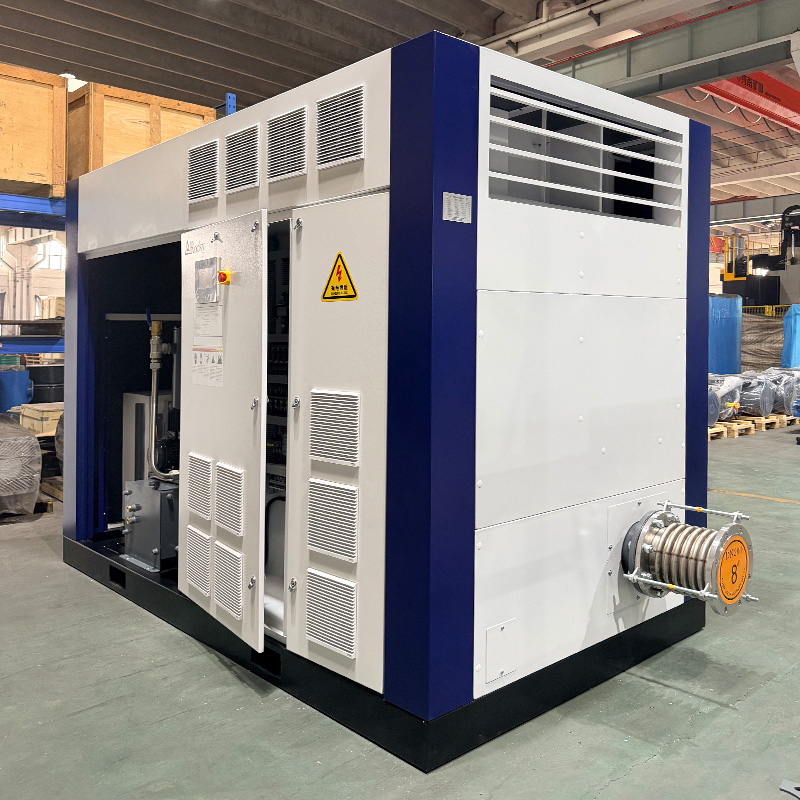 |
The way a blower raises pressure determines its loss profile, discharge temperature, pulsation characteristics, and response to changing system demand. Understanding this distinction makes the later efficiency comparison much easier.
A Roots blower normally contains two synchronized lobed rotors that turn in opposite directions without touching. Air enters the casing, becomes trapped between the rotor and housing, and is carried toward the discharge side. The pocket volume remains nearly constant while it moves through the casing. When the pocket opens to the discharge line, higher-pressure air flows back into it and pressure equalization occurs.
This external-compression process is mechanically simple and predictable. It also creates pressure-equalization loss, discharge pulsation, and heat. Clearances around the rotors allow some reverse leakage, or slip, and the effect normally becomes more important as the pressure ratio rises. Actual efficiency depends on speed, clearances, inlet temperature, pressure ratio, and the selected operating point—not on the technology name alone.
An oil-free screw blower uses intermeshing male and female rotors with helical profiles. As the rotors turn, they trap air and progressively reduce the pocket volume before it reaches the discharge port. Timing gears maintain the designed non-contact clearances, so lubricating oil is not injected into the process-air chamber.
When the built-in pressure ratio is well matched to the system pressure, internal compression reduces the abrupt pressure equalization seen in a lobe blower. The result can be lower specific power, smoother discharge flow, and lower pulsation. A poor match between the blower and system can still cause under-compression or over-compression losses, so selection must be based on the manufacturer's performance map.
Best practice: Compare total package power in kW at identical inlet conditions, flow, and discharge pressure.
Common mistake: Do not compare one machine's maximum flow with another machine's best-efficiency point.
Required check: Confirm that the full operating range stays clear of surge, overheating, motor overload, and any manufacturer-defined prohibited zone.
Energy comparisons should use specific power: total electrical input divided by delivered airflow at the required pressure. Include the main motor, cooling fan, oil pump, controls, and other package auxiliaries. Then apply the measured hourly demand profile to estimate annual kWh. A supplier's maximum-saving percentage is not a substitute for this calculation because the result changes with pressure, turndown, ambient conditions, and the condition of the existing blower.
For a high-flow reference, Rocky lists the RKEB70H-220RS 220 kW Oil-Free Screw Blower at 60 Nm³/min and 2 bar. Those nameplate values help define a candidate size, but an engineering comparison should still request the complete performance curve and package input power at the site's actual normal and maximum operating points.
A Variable Frequency Drive (VFD) can reduce power by matching airflow to process demand instead of venting, throttling, or producing excess air. Oil-free screw blowers are commonly packaged with integrated VFD control and can offer a useful turndown range. Roots blowers can also save energy through speed reduction, provided that the reduced-speed operating point remains inside the allowable range and still meets cooling and lubrication requirements.
The best control strategy depends on the process. Wastewater aeration may use dissolved-oxygen feedback, header-pressure control, or coordinated sequencing of multiple blowers. Pneumatic conveying may require a narrower pressure band and minimum conveying velocity. In either case, define the control objective before sizing the VFD and blower.
Roots blowers commonly produce strong discharge pulsation and low-frequency tonal components. These frequencies can travel through piping and structural elements, making control more difficult than simply adding enclosure foam. A complete acoustic solution may require inlet and discharge silencers, flexible connectors, correctly designed piping supports, vibration isolators, and an enclosure.
Screw blowers normally produce smoother discharge flow and are frequently supplied inside an acoustic canopy. This can simplify noise control, but it does not guarantee a particular sound level. Compare guaranteed sound-pressure data at the same measurement distance and operating condition. After installation, verify workplace exposure with on-site measurements because room reflections, connected piping, ventilation openings, and adjacent equipment can change the result.
An oil-free compression chamber means that oil is not injected into the airflow for sealing, cooling, or lubrication. The timing gears and bearings still require lubrication, so the seal arrangement must keep gearbox oil separate from the process-air path. Inlet air, filters, coatings, piping cleanliness, condensate management, and maintenance practices also affect delivered air quality.
For applications such as food processing, pharmaceuticals, electronics, fermentation, and sensitive pneumatic conveying, request evidence for the exact product configuration. As one concrete example, the RKEB70H-110RS Industrial Oil-Free Screw Blower is listed with a 110 kW motor, 4,368 m³/h capacity, 0.6 bar rated pressure, and ISO 8573-1 Class 0 positioning. Before specifying it for a critical process, confirm the applicable certificate, test method, scope, and operating conditions with the manufacturer.
Packaged screw blowers often integrate the air end, motor, VFD, cooling system, PLC, filtration, and acoustic enclosure. This reduces field assembly but changes the space plan. Allow room for door opening, filter replacement, oil service, cable entry, ventilation, and future air-end removal. Prevent hot discharge air from recirculating into the inlet.
Legacy Roots blower packages may have different inlet and discharge locations, skid dimensions, foundation loads, and pipe velocities. Review flexible joints, check valves, relief valves, silencers, supports, and transition pieces. Existing pipework that is too small can create pressure loss and erase part of the expected energy benefit.
Compact packaging can simplify a retrofit, but the phrase “drop-in” should be treated as a project objective rather than a guarantee. Rocky presents the RKEB70H-160RS Compact Oil-Free Screw Blower as a lobe-blower replacement and lists 42 m³/min at 2 bar. Before ordering, compare the certified dimensional drawing, connection sizes, cooling-air path, electrical load, control interfaces, foundation requirements, and duty point with the installed machine.
Log normal, minimum, and maximum flow and pressure during representative production periods.
Confirm inlet temperature, humidity, altitude, dust loading, and corrosive contaminants.
Measure the available footprint, service clearance, doorway access, and lifting path.
Check pipe diameter, connection position, pressure loss, valve arrangement, and support loading.
Verify voltage, frequency, short-circuit capacity, protection devices, harmonics, and PLC communications.
Review ventilation airflow and the route for removing package heat from the blower room.
Define acceptance tests for flow, pressure, package power, sound level, vibration, and air quality.
Roots blowers are mechanically familiar and can often be serviced by an experienced plant maintenance team. Typical work includes inlet-filter replacement, gear-oil service, bearing inspection, seal checks, belt tensioning and alignment on belt-driven packages, and periodic inspection of the lobes and clearances.
Oil-free screw blowers may use direct-drive or gear-driven arrangements that eliminate external belts. Routine work generally includes inlet-filter service, gearbox lubrication, cooling-system inspection, sensor checks, and condition monitoring. The screw air end is a precision assembly; if an overhaul is required, specialized service may be necessary. Obtain the maintenance schedule, consumable list, overhaul interval, spare-parts pricing, and service response commitment before calculating lifecycle cost.
A proper lifecycle model should include purchase price, installation, annual energy, planned maintenance, consumables, expected overhaul, downtime risk, and residual value. In a continuously operated plant, energy may dominate the calculation. In an intermittent process, the lower capital cost and familiar maintenance of a Roots blower may outweigh a modest efficiency advantage.
The required pressure is relatively low and the selected unit operates close to its efficient range.
The duty cycle is intermittent or annual operating hours are too low to justify a higher initial investment.
Flow demand is stable and deep turndown is unnecessary.
The plant prioritizes mechanical simplicity, local service familiarity, and lower first cost.
A rugged installation is required and the site can provide suitable inlet filtration and acoustic treatment.
The blower will operate continuously or for many hours per year.
The system operates at a moderate or higher blower pressure where internal compression provides a meaningful specific-power advantage.
Demand varies and the process can benefit from VFD control.
Smooth airflow, compact packaging, or easier acoustic attenuation has high operational value.
The process requires an oil-free air path and model-specific air-purity documentation.
Wastewater aeration is a common example because airflow can vary with biological load and energy cost accumulates around the clock. For medium-scale installations, the 22–37 kW Low-Pressure Oil-Free Screw Blower provides a concrete starting point for model comparison. Its published table covers multiple flow and pressure points, but final selection should use the actual aeration demand, diffuser pressure loss, seasonal water depth, fouling allowance, and required redundancy.
Feature | Roots Blower (Lobe) | Oil-Free Screw Blower |
|---|---|---|
Compression Type | External (High Slip) | Internal (Low Slip) |
Ideal Pressure Range | Typically most efficient below 0.5 bar (7 psig), usable up to ~0.8–1.0 bar depending on model | 0.5 to 1.2 bar (7 - 17 psig) range varies by manufacturer/model |
VFD Efficiency | Poor at low speeds | Excellent across wide range |
Noise Profile | Low‑frequency (Hard to attenuate), 85‑95 dB(A) | High‑frequency (Easy to attenuate), 70‑82 dB(A) (model‑dependent) |
A blower selection should stop when the required discharge pressure exceeds the practical range of the available blower models. Trying to force a blower into a compressor duty can create high temperature, poor efficiency, overload, and reliability problems. Rocky's broader oil-free portfolio includes dry screw, water-lubricated screw, scroll, PET bottle, and other compressor designs for applications that need higher pressure than an aeration or conveying blower.
For general contamination-sensitive production air, the 55 kW Dry Oil-Free Screw Air Compressor is listed at 4.4–9.8 m³/min and 7–10 bar, with Class 0 positioning for industries such as food and beverage, pharmaceuticals, electronics, medical production, and precision coating. This pressure range is fundamentally different from typical blower service.
PET bottle production requires another step up in pressure. Rocky's 40 Bar 5 m³/min Oil-Free PET Blowing Screw Air Compressor is presented as a two-stage, water-lubricated solution for 25–40 bar service. This is a clear example of why “oil-free blower” and “oil-free compressor” should not be used as interchangeable purchasing terms.
Establish the system curve. Record flow and pressure across normal production, including filters, diffusers, pipe loss, valves, and seasonal variation.
Define the operating profile. Quantify hours at each load point instead of relying only on peak demand.
Separate blower and compressor duties. Do not compare machines intended for fundamentally different pressure ranges.
Request equivalent quotations. Require each vendor to quote the same flow, pressure, inlet conditions, air-purity requirement, voltage, redundancy, and control method.
Compare package input power. Use guaranteed values at every important duty point and include auxiliary loads.
Calculate lifecycle cost. Include equipment, installation, power, maintenance, overhaul, downtime risk, and financing assumptions.
Validate the installation. Review drawings, piping, electrical supply, ventilation, foundation, access, noise, and controls before releasing the order.
Roots blowers remain a practical choice for many low-pressure duties, particularly when simplicity, low first cost, and familiar maintenance are more important than maximum continuous-duty efficiency. Oil-free screw blowers become compelling when operating hours are high, pressure is toward the upper end of blower service, demand varies, and energy consumption materially affects lifecycle cost.
The final choice should come from data rather than a general technology claim. Conduct a baseline audit, define the complete operating profile, compare guaranteed package performance at identical conditions, and verify the installation requirements. If the process needs pressure beyond the blower range, move to the appropriate oil-free air-compressor technology instead of selecting an oversized or overstressed blower.
Need help matching equipment to an existing aeration, pneumatic conveying, food, pharmaceutical, chemical, textile, or PET production process? Provide the required flow, normal and maximum pressure, inlet conditions, operating hours, demand profile, air-quality requirement, electrical supply, current equipment data, and available installation space.
Rocky's engineering team can use these parameters to compare blower and compressor options, review retrofit constraints, estimate energy consumption, and prepare a site-specific equipment proposal. A detailed data set produces a more accurate selection, a more defensible payback calculation, and fewer installation changes after the equipment arrives.
A: Yes, when the screw blower can meet the complete flow and pressure profile. It is rarely wise to assume a literal one-for-one replacement without checking connection sizes, footprint, foundation, ventilation, electrical load, VFD controls, and maintenance access. Compare certified drawings and performance data before ordering.
A: An oil-free screw blower often has an advantage at moderate pressure ratios and long operating hours because it uses internal compression. The actual result depends on the duty point, turndown, inlet conditions, package auxiliaries, and the condition of the alternative Roots blower. Compare guaranteed specific power across the measured load profile.
A: Both can have oil-free compression chambers. Gearboxes and bearings still require lubrication, so seal design and maintenance matter. If the process requires ISO 8573-1 Class 0, verify documentation for the exact model and configuration rather than relying only on the phrase “oil-free.”
A: Choose an air compressor when the required pressure exceeds the approved operating range of the blower. Plant production air commonly operates at several bar, while specialized PET bottle blowing can require tens of bar. Start with required flow and pressure, then define air purity, dew point, duty cycle, and redundancy.
A: Send minimum, normal, and maximum flow; normal and maximum discharge pressure; inlet temperature, humidity, and altitude; operating hours; demand variation; air-quality and dew-point requirements; voltage and frequency; installation dimensions; ambient conditions; and details of the existing blower or compressor. These inputs allow the supplier to select a realistic operating point and calculate expected energy use.


